


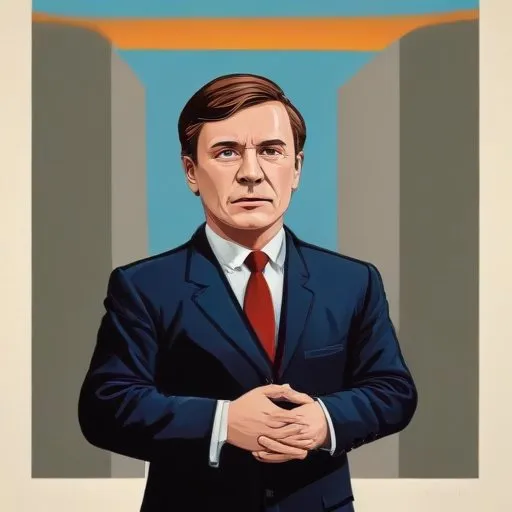
The 5th Prime Minister of Estonia in exile, a leader who played a crucial role in maintaining Estonia's government during World War II and the subsequent Soviet occupation. He ensured the continuation of Estonia's sovereignty and independence.
Heinrich Mark was a stalwart Estonian politician who served as the Prime Minister of the Estonian Government in Exile and the last Estonian head of state in exile, playing a pivotal role in Estonia's struggle for independence.
Mark was born on October 1, 1911, in Estonia, and grew up with three brothers, Adolf, Albert, and Aksel. His brothers went on to pursue different careers, with Adolf dying in a Siberian prison camp, Albert being killed as a Forest Brother, and Aksel becoming an agronomist, journalist, and Estonian Minister of the Interior in exile.
Mark studied in Vru and graduated from the Teachers' Seminar of Tartu. He further pursued his education at the University of Tartu, studying law from 1933 to 1938.
Mark began his career as an elementary school teacher from 1938 to 1940. During this period, he also worked as a solicitor to the barrister P. Sepp in Tartu. His brief stint as a secretary of Tartu University in 1940 was cut short when he was advised to leave by the rector Hans Kruus due to the occupation of Estonia.
Mark's involvement in politics intensified during World War II. In 1940, he was put up as a candidate for the Riigivolikogu elections but was deleted from the list of candidates. He later went into hiding in Estonia and eventually escaped to Finland in 1943, where he became one of the organizers of the Estonian Bureau, an Estonian exile organization.
In 1944, Mark moved to Sweden, where he played a crucial role in the Estonian Committee. He held various positions, including Chairman of the education working group, Director of the Bureau, and Chairman of the Estonian Committee, eventually becoming the Honorary Chairman in 1982.
Heinrich Mark's unwavering dedication to Estonia's independence and his role as the last Estonian head of state in exile have left an indelible mark on the country's history. His contributions to the Estonian Committee and his work in exile have inspired generations of Estonians.
Heinrich Mark passed away on August 2, 2004, leaving behind a legacy that continues to inspire and motivate Estonians around the world.
89 Years Old
A Finnish statesman and Nobel laureate who served as President of Finland and mediated several international conflicts, earning him the Nobel Peace Prize in 2008.
97 Years Old
Estonian filmmaker and statesman who served as the country's president from 1992 to 2001, known for his efforts to integrate Estonia into the European Union and NATO. He was also a prolific writer and director, producing several documentaries and feature films.
90 Years Old
A minimalist composer renowned for his sacred, hauntingly beautiful music that often features slow, contemplative harmonies and sparse textures, evoking a sense of spirituality and calm.
72 Years Old
A Swedish-Estonian journalist and politician who served as the 4th President of Estonia, known for his efforts to promote e-government and digitalization in the country. He's a strong advocate for a free and open internet.
56 Years Old
The first female President of Estonia, serving from 2016 to 2021, known for her strong advocacy for climate action, digitalization, and e-government. She has been a vocal critic of authoritarianism and a champion of liberal democracy.
48 Years Old
The 42nd Mayor of Tallinn, Estonia's capital, who served from 2005 to 2007 and later became the country's Prime Minister from 2016 to 2021, known for his efforts to strengthen Estonia's economy and digital infrastructure.
69 Years Old
Estonia's first Prime Minister to serve two consecutive terms, he led the country's digital revolution, making Estonia a global leader in e-government and digital innovation.
77 Years Old
The first Estonian to hold a high-ranking position in the European Commission, known for his efforts to modernize and integrate Estonia into the European Union. He played a key role in Estonia's accession to the EU and the eurozone.
