


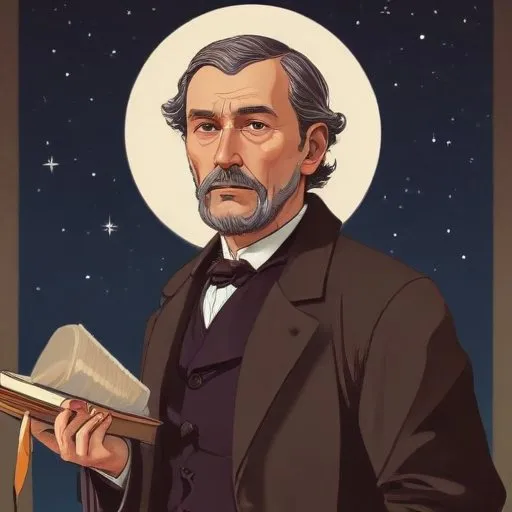
A German astronomer who discovered the 11-year sunspot cycle, making significant contributions to our understanding of the Sun's activity.
Heinrich Schwabe, a German amateur astronomer, is renowned for his groundbreaking work on sunspots, leaving an indelible mark on the field of solar astronomy. Through his meticulous observations and drawings, Schwabe discovered the 10-year cycle of sunspot activity, revolutionizing our understanding of the sun's behavior.
Born on October 25, 1789, in Dessau, Germany, Schwabe was the son of a physician to the duke. His mother was the daughter of an apothecary, Johann H. G. Hseler, and Schwabe initially trained to be an apothecary himself, joining the Dessau Mohrenapotheke owned by his grandfather in 1806. However, his interests soon shifted to pharmacy, astronomy, and botany, leading him to study at the University of Berlin under the guidance of Martin Heinrich Klaproth and Sigismund Friedrich Hermbstdt.
After inheriting the family pharmacy business, Schwabe continued to pursue his passion for astronomy in his spare time. In 1825, he acquired his first telescope through a lottery, and on October 30, 1825, began his systematic observations of sunspots. Schwabe's dedication to the field was evident in his daily recordings of sunspots, which he continued for over 40 years, making him one of the most prolific sunspot observers of his time.
Schwabe's fascination with the sun led him to search for a theoretical planet, Vulcan, believed to be orbiting inside Mercury's orbit. For 17 years, from 1826 to 1843, Schwabe scanned the sun on every clear day, meticulously recording sunspots in hopes of detecting the elusive planet. Although his search for Vulcan remained unsuccessful, his efforts laid the foundation for future sunspot research.
Schwabe's work on sunspots not only revealed the 10-year cycle of sunspot activity but also inspired future generations of astronomers. His observations and drawings of sunspots remain some of the most valuable records of sunspot activity in the pre-photographic era. Schwabe's findings have had a lasting impact on our understanding of the sun's behavior, paving the way for further research in solar astronomy.
Aside from his scientific pursuits, Schwabe was a founding member of the Natural History Society in Dessau, demonstrating his commitment to the community and his passion for natural history. Schwabe's contributions to science and society continue to inspire and educate, leaving a lasting legacy in the world of astronomy.
Schwabe's remarkable story serves as a testament to the power of dedication and passion in advancing our understanding of the universe. His work continues to inspire scientists and astronomers, leaving an enduring legacy in the field of solar astronomy.
Born in 1571
A 17th-century trailblazer who discovered the three laws of planetary motion, revolutionizing our understanding of the solar system. He's also credited with being a pioneer in the field of astrology.
Born in 1564
Pioneering astronomer, physicist, and mathematician who played a major role in the Scientific Revolution, making key discoveries that challenged Aristotelian views and laid the foundation for modern science.
Born in 1546
A 16th-century astronomer who made precise measurements of the stars and planets, laying the foundation for modern astronomy. His data helped Kepler discover planetary orbits.
Born in 1473
A Renaissance-era mathematician and astronomer who proposed the heliocentric model, where the Sun is at the center of our solar system, revolutionizing our understanding of the universe.
Born in 1784
Developed the Bessel functions, a set of mathematical equations crucial for astronomy, navigation, and engineering, and made the first accurate measurement of a star's distance from Earth.
Born in 1777
A pioneer in mathematics and physics, he made major contributions to number theory, algebra, and electromagnetism, shaping our understanding of the natural world.
Born in 1749
Developed nebular hypothesis of the origin of the solar system and formulated Laplace's equation, a fundamental concept in mathematics and physics. He's considered the founder of celestial mechanics.
Born in 1811
Predicted the existence and location of Neptune, a previously unknown planet, through mathematical calculations, revolutionizing astronomy.
