


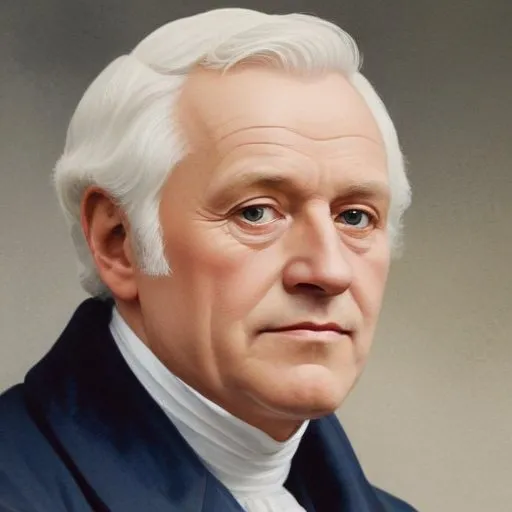
A German physician and astronomer who discovered two asteroids, Pallas and Vesta, and proposed the Olbers' Paradox, a theory about the darkness of the night sky. They made significant contributions to the field of astronomy, shaping our understanding of the universe.
Heinrich Wilhelm Matthias Olbers, a German astronomer, etched his name in the annals of history with his groundbreaking method of calculating cometary orbits and the discovery of two asteroids, Pallas and Vesta. Olbers' remarkable contributions to astronomy paved the way for a deeper understanding of our celestial neighborhood.
Born on October 11, 1758, in Arbergen, Germany (now part of Bremen), Olbers' fascination with the night sky began at a young age. He pursued his passion for medicine and mathematics at Göttingen University, where he studied under the guidance of Abraham Gotthelf Kästner.
In 1779, while attending to a sick fellow student, Olbers devised a method of calculating cometary orbits that revolutionized the field. This innovative approach made him an overnight sensation in the astronomy community, earning him a place among the esteemed "celestial police" group in 1800.
In 1823, Olbers formulated a paradox that would challenge the understanding of the universe: why is the night sky dark if the universe is infinite and eternal? This paradox, later reformulated in 1826, sparked debate and inspired new theories about the nature of the cosmos.
Olbers' pioneering work paved the way for future astronomers, influencing the development of modern astronomy. His discoveries and contributions have left an indelible mark on our understanding of the solar system, leaving behind a legacy that continues to inspire new generations of astronomers and scientists.
"The celestial bodies are the instruments of the universe, and the universe is the symphony."
Olbers' work was contemporaneous with that of other notable astronomers, such as Carl Friedrich Gauss and Friedrich Wilhelm Bessel. While each made significant contributions to their field, Olbers' discoveries and paradoxes uniquely bridged the gap between cometary orbits and the mysteries of the universe.
Born in 1777
A pioneer in mathematics and physics, he made major contributions to number theory, algebra, and electromagnetism, shaping our understanding of the natural world.
Born in 1784
Developed the Bessel functions, a set of mathematical equations crucial for astronomy, navigation, and engineering, and made the first accurate measurement of a star's distance from Earth.
Born in 1811
Predicted the existence and location of Neptune, a previously unknown planet, through mathematical calculations, revolutionizing astronomy.
Born in 1749
Developed nebular hypothesis of the origin of the solar system and formulated Laplace's equation, a fundamental concept in mathematics and physics. He's considered the founder of celestial mechanics.
Born in 1736
Developed calculus, number theory, and celestial mechanics, making significant contributions to the fields of mathematics and astronomy.
Born in 1738
A pioneering astronomer and musician who discovered Uranus and two of its moons, and also composed symphonies and concertos.
