


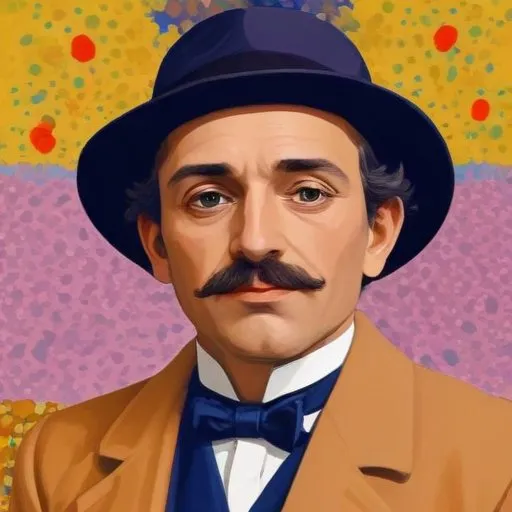
A pioneering artist who developed the Pointillist style, creating vibrant, dreamlike landscapes and seascapes using tiny dots of color. He also inspired a generation of avant-garde artists .
Henri Edmond Cross, a French painter and printmaker, is renowned for his pivotal role in shaping the second phase of Neo-Impressionism, a movement that revolutionized the art world in the late 19th and early 20th centuries. His innovative techniques and vibrant palette influenced a generation of artists, including Henri Matisse, and paved the way for the development of Fauvism.
Born Henri Edmond Joseph Delacroix on May 20, 1856, in Douai, France, Cross grew up in a family with a rich history of ironmongery. His parents, Alcide Delacroix and Fanny Woollett, recognized his artistic talent at an early age, and his cousin, Dr. Auguste Soins, financed his first drawing lessons under the tutelage of Carolus-Duran.
Cross's artistic education continued in Paris, where he studied with Franois Bonvin and later at the coles Acadmiques de Dessin et d'Architecture under Alphonse Colas. He also received guidance from fellow Douai artist mile Dupont-Zipcy after moving to Paris in 1881.
In the early 1880s, Cross's work was characterized by dark, realistic colors, but he soon began to experiment with brighter, more vibrant hues. His trip to the Alpes-Maritimes in 1883, accompanied by his family and Dr. Soins, marked a turning point in his artistic development. It was during this period that he adopted the name Henri Cross, distinguishing himself from the famous Romantic painter Eugne Delacroix.
In 1881, Cross exhibited his work for the first time at the Salon des Artistes Franais, and his early landscapes, such as Alpes-Maritimes (1883), showcased his growing fascination with light and color.
Cross's innovative approach to art, which emphasized the use of small, distinct dots of color to create a sense of vibrancy and movement, earned him recognition as a master of Neo-Impressionism. His work influenced a generation of artists, including Henri Matisse, who would go on to develop Fauvism.
Cross's most famous works, such as The Clearing (1896) and The Pink Beach (1897), exemplify the principles of Neo-Impressionism, with their intricate patterns of color and light. These works not only showcased Cross's technical skill but also his ability to evoke a sense of serenity and harmony.
Cross's impact on modern art cannot be overstated. His work paved the way for the development of Fauvism, Cubism, and even Abstract Expressionism. Artists such as Matisse, André Derain, and Maurice de Vlaminck were all influenced by Cross's innovative techniques and vibrant palette.
In addition to his artistic contributions, Cross was also a dedicated teacher and mentor. He was a member of the Société des Artistes Indépendants and exhibited regularly at the Salon des Indépendants, where he showcased his work alongside other avant-garde artists.
Cross's personal life was marked by tragedy, including the loss of his mother in 1889 and his cousin, Dr. Soins, in 1892. Despite these challenges, Cross continued to paint, and his work became increasingly introspective and melancholic.
In his later years, Cross's health began to decline, and he was forced to abandon his beloved Mediterranean coast. He died on May 16, 1910, at the age of 53, leaving behind a legacy as a pioneer of Neo-Impressionism and a master of light and color.
Cross was awarded the gold medal at the Salon des Artistes Franais in 1900 and was also honored with the Légion d'Honneur in 1905.
Henri Edmond Cross's innovative spirit, technical mastery, and unwavering dedication to his art have ensured his place as one of the most important artists of the late 19th and early 20th centuries. His legacy continues to inspire artists, art historians, and enthusiasts alike, and his work remains a testament to the power of creativity and innovation.
Born in 1863
A French Post-Impressionist painter and educator, known for developing the Pointillist style, characterized by tiny dots of color that form vibrant, shimmering images. He also wrote about art theory and advocated for the importance of artistic education.
Born in 1869
A pioneering artist who revolutionized modern art with bold, expressive, and colorful works that blurred the lines between painting and sculpture, creating a new language of form and color.
Born in 1880
A pioneer of Fauvism, a style characterized by vivid colors and energetic brushstrokes, creating a new language of art that paved the way for modernist movements.
Born in 1870
A group of Post-Impressionist avant-garde artists who emphasized emotional and expressive qualities in their work, characterized by bold colors and flat forms. They sought to break free from traditional representation in art.
Born in 1881
A pioneering artist who transformed modern art with pioneering Cubist works, creating a new visual language that continues to inspire and influence art, design, and culture.
Born in 1882
A pioneer of Cubism, creating fragmented forms and multiple perspectives in art, revolutionizing modern art movements.
Born in 1877
A Fauvist painter and illustrator celebrated for vibrant, expressive works that captured the essence of modern life, from landscapes to still lifes, and even textiles and ceramics.
Born in 1877
A Fauvist painter who captured the vibrant spirit of Parisian nightlife and high society with bold, expressive brushstrokes and vivid colors.
