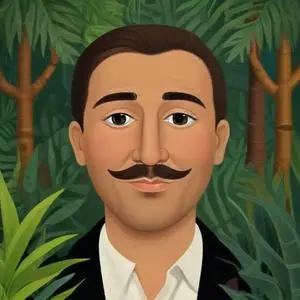
Henri Rousseau

Henri Rousseau

Henri Rousseau was born on May 21st, 1844

Full Name: Henri Rousseau
Profession: French Painter
Nationality: French
Occupation: Painter
Notable Work: Naive Art
Date of Birth: 1844
Place of Birth: Laval, France
Known For: Naive Art Movement

A self-taught artist who created vibrant, dreamlike jungle scenes and naive portraits, blending fantasy and realism with a unique, primitive style.

Written by: Thomas Blackwood Thomas Blackwood

The Customs Officer Turned Artistic Visionary

Henri Rousseau, also known as Le Douanier, was a French post-impressionist painter renowned for his naïve, dreamlike, and enigmatic works of art. Rousseau's unique style, characterized by a flat, two-dimensional perspective and vibrant, unbridled colors, has captivated art enthusiasts and inspired generations of avant-garde artists.

Early Life and Career

Born in Laval, Mayenne, France in 1844, Rousseau came from a humble background, the son of a tinsmith. His early life was marked by turmoil, with his family forced to leave their home after his father's business failed. Rousseau attended Laval High School, where he demonstrated a talent for drawing and music. He later worked for a lawyer, studied law, and served in the army for four years.

The Rise of Le Douanier

Rousseau's artistic journey began in earnest in his early forties, when he started painting seriously. By 49, he had retired from his job as a customs officer to focus on his art full-time. Despite initial ridicule from critics, Rousseau's work gradually gained recognition, and he became a celebrated figure in the art world.

Major Works and Legacy

Rousseau's oeuvre includes some of the most iconic works of post-impressionism, such as "Tiger in a Tropical Storm Surprised" (1891) and "The Sleeping Gypsy" (1897). His paintings, often depicting jungle scenes, fantastical creatures, and introspective figures, continue to fascinate audiences with their simplicity, elegance, and emotional depth.

Influence on Modern Art

Rousseau's innovative style and technique have inspired an array of artists, including Pablo Picasso, Henri Matisse, and Salvador Dalí. His work has also influenced the development of Surrealism, Fauvism, and Cubism.

Personal Life and Milestones

Rousseau married twice, first to Clémence Boitard in 1868, with whom he had six children, and then to Josephine Noury in 1898. His personal life was marked by tragedy, including the death of his first wife in 1888. Despite these challenges, Rousseau remained dedicated to his art, and his legacy continues to shape the art world.

Philosophical Contributions and Beliefs

Rousseau's art embodies a profound sense of innocence, simplicity, and purity. His rejection of traditional techniques and conventions reflects a desire to create art that is authentic, intuitive, and expressive. Through his work, Rousseau advocated for the importance of emotional sincerity and the power of imagination.

Legacy and Recognition

Today, Rousseau's paintings are held in high esteem, with many housed in esteemed museums and private collections around the world. His art has been the subject of numerous exhibitions, monographs, and critical studies. The Musée d'Orsay in Paris has an extensive collection of his works, and his art continues to inspire new generations of artists, curators, and enthusiasts.

Quirks and Trivia

Conclusion

Henri Rousseau's remarkable story is a testament to the power of creativity, perseverance, and innovation. His art continues to captivate audiences, inspiring us to rethink the boundaries of creativity and imagination. As we reflect on his remarkable legacy, we are reminded that even the most unlikely of artists can achieve greatness with dedication, passion, and a willingness to defy convention.
Timeline
1844
Born in Laval
Henri Rousseau was born in Laval, France. He would go on to become a self-taught French painter known for his naive and post-Impressionist style.
1871
Working as a Customs Officer
Rousseau worked as a customs officer in Paris, where he began painting in his spare time.
1886
First Exhibition
Rousseaus work was first exhibited at the Salon des Indépendants, marking the beginning of his career as a painter.
1893
Meeting with Alfred Jarry
Rousseau met with writer Alfred Jarry, who would introduce him to the artistic circle of Paris.
1910
Died in Paris
Rousseau passed away in Paris, leaving behind a unique and influential body of work.
Henri Rousseau

Henri Rousseau Quiz

What style of art is Henri Rousseau's work often classified as?

Score: 0/5
FAQ
What style of painting did Henri Rousseau practice?
Henri Rousseau was a French painter who practiced a naive, or primitive, style of art. His work often featured jungle scenes, exotic landscapes, and fantastical creatures.
What was Henri Rousseaus most famous work?
Henri Rousseaus most famous work is arguably The Sleeping Gypsy, a painting depicting a lion gazing at a sleeping woman in a jungle setting. This work showcases his unique style and imagination.
Where did Henri Rousseau study art?
Henri Rousseau was largely self-taught as an artist, having studied art independently without formal training. He was influenced by various art movements and styles, including Post-Impressionism and Fauvism.
What was Henri Rousseaus relationship with the art world?
Henri Rousseau was initially met with skepticism and criticism by the art world, due to his unconventional style and lack of formal training. However, he gained recognition and acclaim later in life, influencing a generation of artists, including Pablo Picasso and Henri Matisse.
What is Henri Rousseaus legacy?
Henri Rousseaus legacy lies in his innovative and imaginative style, which has inspired generations of artists. He is recognized as a pioneering figure in the development of modern art, particularly in the realm of naive and folk art.

Related People:

Paul Gauguin

Born in 1848

A post-Impressionist master who broke away from traditional European art forms, creating bold, expressive, and emotive works that explored the human experience and the beauty of the natural world.

Born in 1840

A pioneering figure in naturalist literature, known for his influential novels that exposed social ills and championed reform, such as "Germinal" and "Nana".

Camille Pissarro

Born in 1830

A Danish-French Impressionist painter who captured the beauty of landscapes and cityscapes with vivid colors and bold brushstrokes, influencing the development of modern art.

Alfred Sisley

Born in 1839

A landscape painter who captured the essence of rural France and England through his Impressionist works, often focusing on the fleeting effects of light and atmosphere.

Claude Monet

Born in 1840

A founder of Impressionism, capturing fleeting light and color in dreamy landscapes and water scenes, revolutionizing modern art.

Pierre-Auguste Renoir

Born in 1841

A pioneer of Impressionism, creating vibrant, intimate portraits and landscapes that capture the beauty of everyday life. His works evoke a sense of joy and warmth, celebrating the human experience.

Paul Cézanne

Born in 1839

A post-Impressionist pioneer, he's famous for his still-life compositions and landscapes that laid the groundwork for Cubism, influencing 20th-century art.

Edgar Degas

Born in 1834

A master of capturing the beauty of movement and everyday life, this artist is renowned for their stunning Impressionist paintings, sculptures, and illustrations of dancers, horses, and Parisian scenes.