


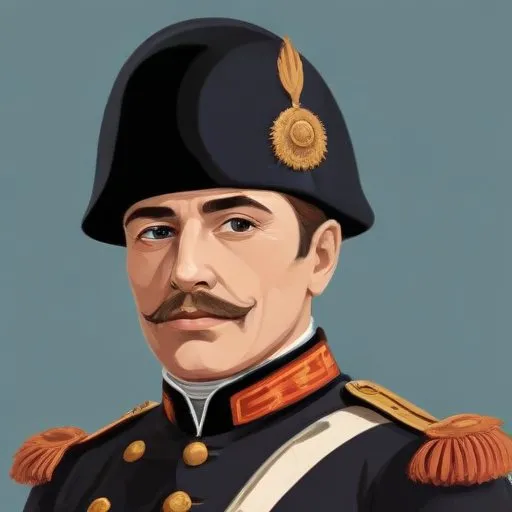
A French military leader and diplomat who played a key role in the War of the Spanish Succession and was a prominent figure in European politics during the late 17th and early 18th centuries. He's also known for his involvement in the Siege of Barcelona.
Henri de Massue, Earl of Galway, was a renowned French Huguenot soldier and diplomat who played a pivotal role in shaping European history during the 17th and 18th centuries. He is best known for his leadership in the Nine Years War and the War of the Spanish Succession, as well as his influential diplomatic missions on behalf of Louis XIV and William III of England.
Born on April 9, 1648, in Paris, France, Henri de Massue was the son of the 1st Marquis de Ruvigny, a distinguished French diplomat. He followed in his father's footsteps, serving as a soldier in the French army under the legendary Turenne. Massue's exceptional skills and strategic thinking earned him recognition, and he was soon selected by Louis XIV to carry out secret negotiations with Charles II of England in 1678.
Massue's diplomatic prowess impressed Louis XIV, who offered him a prominent position in the French government. However, following the Revocation of the Edict of Nantes in 1685, Massue, a devout Huguenot, refused the offer and chose exile instead. He joined his fellow Huguenots in England, where he entered the service of William III as a major-general in 1690.
In 1691, Massue distinguished himself at the Battle of Aughrim, and in 1692, he was appointed commander-in-chief in Ireland. His exceptional leadership and military strategies earned him the title of Viscount Galway and Baron Portarlington, along with a significant grant of seized estates in Ireland.
In 1693, Massue fought bravely at Neerwinden and was wounded. He later led a force in English pay to assist the Duke of Savoy against the French in 1694. After a brief period of neutrality in the Italian peninsula, Galway's force was withdrawn to the Netherlands. From 1697 to 1701, he was practically in control of Irish affairs as Lord Justice.
Henri de Massue, Earl of Galway, left an indelible mark on European history through his military prowess, diplomatic acumen, and commitment to his faith. His remarkable life serves as a testament to the complexities and challenges of the 17th century, and his story continues to inspire and educate historians and scholars to this day.
Born in 1710
The monarch who ruled France from 1715 to 1774, known as the "Sun King's" great-grandson, and remembered for his extravagance, absolutism, and the decline of the French monarchy.
Born in 1633
The last Catholic monarch of England, Scotland, and Ireland, who attempted to restore Catholicism and absolute monarchy, sparking the Glorious Revolution. He's infamous for his authoritarian rule and religious intolerance.
Born in 1650
The Prince of Orange, King of England, Scotland, and Ireland, led the Glorious Revolution, overthrowing the Catholic King James II, and ruled with his wife Mary II, establishing a Protestant monarchy. He's also known for his military victories in Ireland and Europe.
Born in 1710
The monarch who ruled France from 1715 to 1774, known as the "Sun King's" great-grandson, and remembered for his extravagance, absolutism, and the decline of the French monarchy.
Born in 1674
The Regent of France from 1715 to 1723, known for his cultural and artistic patronage, and his role in shaping the country's politics during a period of significant change.
Born in 1666
King of Sardinia from 1720 to 1730, he played a crucial role in the War of the Spanish Succession and was eventually crowned King of Sicily. He's known for his military campaigns and territorial expansions.
Born in 1676
The first Prime Minister of the United Kingdom, serving from 1721 to 1742, known for establishing the office of Prime Minister and setting important precedents for the role. He is also recognized for his skill in managing Parliament and his role in shaping British politics.
