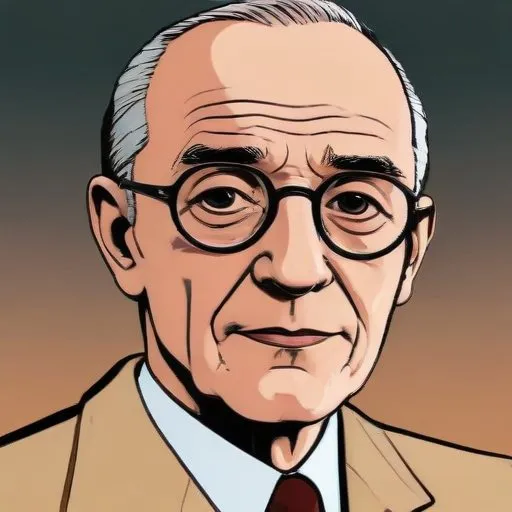
Henry Bauchau

Henry Bauchau

Henry Bauchau was born on January 22nd, 1913

Full Name: Henry Bauchau
Birthplace: Liège, Belgium
Zodiac Sign: Unknown
Profession: Psychoanalyst, author
Notable Work: French literature
Awards: Prix Médicis
Died: September 21, 2012
Influence: 20th-century psychology

A Belgian psychoanalyst and author who explored the human psyche through his writings, delving into the complexities of human relationships and emotions. His works often blurred the lines between psychoanalysis and literature.

Written by: Oliver Wren Oliver Wren

Henry Bauchau was a Belgian psychoanalyst, lawyer, and writer, known for his profound contributions to the world of literature, psychology, and law. Born on January 22, 1913, in Mechelen, Belgium, Bauchau's life was a testament to his insatiable curiosity and passion for exploration.

Bauchau's early life was marked by his pursuit of a law degree, which he obtained in 1936. He went on to become a trial lawyer in Brussels, where he honed his skills in the courtroom. However, his life took a dramatic turn during World War II, when he joined the Belgian Resistance in the Ardennes, demonstrating his courage and commitment to fighting against oppression.

In 1945, Bauchau shifted his focus to publishing, a profession he would continue to pursue until 1951. It was during this period that he befriended some of the most influential figures of the time, including Albert Camus, André Gide, Jacques Lacan, and Jacques Derrida. This association would have a profound impact on his writing style and philosophical outlook.

Bauchau's literary output was staggering, with a diverse range of works that showcased his mastery of various genres. Some of his notable works include:
  • Géologie (1958), a poetic exploration of the human condition
  • Gengis Khan (1960), a historical epic that delves into the life of the Mongol emperor
  • La Machination (1969), a play that critiques the machinations of power
  • Oedipus on the Road (1997), a poetic reimagining of the ancient Greek tragedy
  • La Chine intérieure (1974), a collection of poems that explores the inner landscape of China
  • Essai sur la vie de Mao Tsé-toung (1982), a biographical exploration of the Chinese communist leader

Bauchau's writing often grappled with fundamental questions about human existence, morality, and the nature of power. His work was deeply influenced by his experiences during World War II, as well as his associations with prominent philosophers of the time. Through his writing, Bauchau sought to explore the complexities of human nature and the search for meaning in a chaotic world.

Bauchau's personal life was marked by his marriage to Mary Kozyrev, with whom he had a son, the actor Patrick Bauchau. The family lived in Gstaad, Switzerland, for a time, before eventually settling in Paris, France. Bauchau's later years were marked by a steady stream of literary output, as well as recognition for his contributions to literature and philosophy.

Henry Bauchau's legacy is a testament to his boundless energy and creativity. Through his diverse range of works, he has left an indelible mark on the world of literature, psychology, and philosophy. His contributions continue to inspire and challenge readers to this day, ensuring that his work remains relevant and timely.

Bauchau's work was recognized with several prestigious awards, including the Royal Academy of Belgian Literature in 1990 and the International Latin Union prize of Romance Language Literatures in 2002.

"I believe that writing is a way of exploring the unknown, of confronting the abyss that lies within us." - Henry Bauchau

Bauchau's life and work are a reflection of the tumultuous times in which he lived. His writing provides a unique window into the experiences of the 20th century, offering insights into the human condition that continue to resonate today.

Bauchau's work can be situated alongside that of his contemporaries, such as Albert Camus and Jean-Paul Sartre, who also grappled with the complexities of human existence and the search for meaning in a chaotic world. While his style and philosophical outlook were distinct, his contributions to the literary and philosophical landscape of the 20th century are undeniable.

Timeline
1913
Born in Mechelen, Belgium
Henry Bauchau was born in Mechelen, Belgium, to a family of intellectuals. He would go on to become a prominent psychoanalyst and author.
1940
Studies Psychoanalysis
Bauchau studied psychoanalysis under the tutelage of prominent psychoanalysts, including Jacques Lacan.
1960
Becomes Prominent Psychoanalyst
Bauchau became a prominent psychoanalyst in Belgium, known for his work on the intersection of psychology and philosophy.
1980
Publishes Literary Works
Bauchau published several literary works, including novels and essays, that explored the human condition.
2012
Dies at Age 98
Henry Bauchau died at the age of 98, leaving behind a legacy of contributions to psychoanalysis and literature.
Henry Bauchau

Henry Bauchau Quiz

What is a distinctive feature of Henry Bauchau's writings?

Score: 0/5
FAQ
What was Henry Bauchaus background in psychoanalysis?
Henry Bauchau was a Belgian psychoanalyst who studied under Jacques Lacan and later became a prominent figure in the French psychoanalytic community.
What was Henry Bauchaus approach to psychotherapy?
Henry Bauchau developed an approach to psychotherapy that focused on the patients narrative and the role of language in shaping the unconscious.
How did Henry Bauchaus work influence French literature?
Henry Bauchaus work on psychoanalysis and literature influenced a generation of French writers, including Michel Foucault and Jacques Derrida.
What was Henry Bauchaus relationship with Jacques Lacan?
Henry Bauchau was a close associate and student of Jacques Lacan, and later became a prominent critic of Lacans theories.
How is Henry Bauchau remembered as a psychoanalyst?
Henry Bauchau is remembered as a pioneering psychoanalyst who bridges the gap between psychotherapy and literature. His work continues to influence contemporary thought on the human psyche.

Related People:

Jacques Lacan

Born in 1901

A French psychiatrist and psychoanalyst who developed influential theories on the human psyche, particularly the concept of the "mirror stage" and the role of language in shaping our sense of self.

Sigmund Freud

Born in 1856

Pioneering psychoanalyst who developed theories on the subconscious mind, childhood experiences, and the structure of personality, revolutionizing our understanding of human behavior and psychology.

Carl Jung

Born in 1875

Developed the concept of collective unconscious and archetypes, and founded analytical psychology, which emphasizes the integration of opposites and the process of individuation.

Erich Fromm

Born in 1900

A German psychologist and sociologist who developed the concept of "social character" and explored the relationship between psychology and society, known for his humanistic and socialist approach.

Jean-Paul Sartre

Born in 1905

Existentialist philosopher and playwright who argued that humans have complete freedom to choose their actions and create their own meaning in life, influencing modern thought on morality and individual responsibility.

Martin Heidegger

Born in 1889

A German philosopher and academic who explored the meaning of existence, time, and human existence, influencing 20th-century philosophy with his concept of "Being-in-the-world".

Simone de Beauvoir

Born in 1908

A pioneering feminist philosopher who wrote extensively on ethics, politics, and gender, famously arguing that "one is not born, but rather becomes, a woman."

Franz Kafka

Born in 1883

A writer of surreal, psychologically complex fiction that explores the human condition, often featuring isolated protagonists in absurd, nightmarish scenarios.