


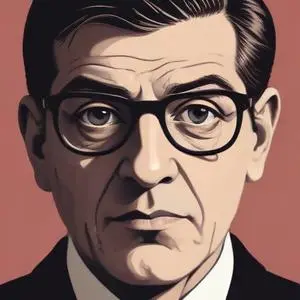
A French psychiatrist and psychoanalyst who developed influential theories on the human psyche, particularly the concept of the "mirror stage" and the role of language in shaping our sense of self.
Jacques Lacan, a French psychoanalyst and psychiatrist, is known for his groundbreaking work that challenged the traditional norms of psychoanalysis, earning him the title of the most controversial psychoanalyst since Freud. His innovative approaches and conceptualizations have had a profound impact on continental philosophy, cultural theory, and the practice of psychoanalysis itself.
Born on April 13, 1901, in Paris, France, Lacan was the eldest of three children to Émilie and Alfred Lacan. His father was a successful soap and oils salesman, while his mother was an ardent Catholic. Lacan's upbringing was marked by tensions between his religious upbringing and his growing interest in philosophy, which eventually led him to abandon his faith for atheism.
Lacan's academic journey began at the Collège Stanislas, where he developed a passion for philosophy, particularly the works of Spinoza. He went on to study medicine and psychiatry, eventually earning his medical degree in 1932. His early work focused on psychoanalysis, and he became a member of the International Psychoanalytic Association (IPA) in 1934.
Lacan's most notable works include his yearly seminars in Paris, which he conducted from 1953 to 1981, and his published papers, which were later collected in the book Écrits. The transcriptions of his seminars, given between 1954 and 1976, were also published and have had a significant impact on the field of psychoanalysis.
Lacan's work was characterized by his emphasis on the philosophical dimension of Freudian thought. He applied concepts derived from structuralism in linguistics and anthropology to develop his own theories, which he augmented with formulae from predicate logic and topology. This approach led to his expulsion from the IPA and the establishment of his own psychoanalytic institutions.
Lacan's work challenged the traditional norms of psychoanalysis, instead focusing on the importance of the "mirror stage" in child development, the concept of the "Real" (the unattainable, unsymbolizable aspect of reality), and the significance of language in shaping human experience.
Lacan's ideas have had a profound impact on various fields, including poststructuralism, critical theory, feminist theory, and film theory. His concepts, such as the "mirror stage" and the "gaze," have been applied in fields beyond psychoanalysis, influencing thinkers like Jean Baudrillard, Gilles Deleuze, and Slavoj Žižek.
Lacan's work has also inspired artists, writers, and filmmakers, including David Lynch, Terry Eagleton, and Todd Solondz. His ideas have been used to analyze and critique societal norms, power structures, and the human condition.
Lacan's unconventional approaches and critiques of traditional psychoanalysis led to controversy and criticism from his peers. His expulsion from the IPA and the establishment of his own institutions were seen as a challenge to the established order.
Despite the controversy, Lacan's work has been widely recognized and celebrated, earning him a reputation as one of the most important and influential thinkers of the 20th century.
Jacques Lacan's work has left an indelible mark on the field of psychoanalysis and beyond. His innovative approaches, critiques, and conceptualizations have inspired generations of thinkers, artists, and scholars.
Today, Lacan's work continues to influence research, theory, and practice in fields such as psychology, philosophy, cultural studies, and literary theory, cementing his legacy as one of the most important and influential thinkers of the 20th century.
Born in 1856
Pioneering psychoanalyst who developed theories on the subconscious mind, childhood experiences, and the structure of personality, revolutionizing our understanding of human behavior and psychology.
Born in 1875
Developed the concept of collective unconscious and archetypes, and founded analytical psychology, which emphasizes the integration of opposites and the process of individuation.
Born in 1905
Existentialist philosopher and playwright who argued that humans have complete freedom to choose their actions and create their own meaning in life, influencing modern thought on morality and individual responsibility.
Born in 1889
A German philosopher and academic who explored the meaning of existence, time, and human existence, influencing 20th-century philosophy with his concept of "Being-in-the-world".
Born in 1908
A pioneering feminist philosopher who wrote extensively on ethics, politics, and gender, famously arguing that "one is not born, but rather becomes, a woman."
Born in 1896
Developed groundbreaking theories on child cognitive development and learning, emphasizing active discovery and hands-on experience. His work has shaped modern education and parenting practices.
Born in 1900
A German psychologist and sociologist who developed the concept of "social character" and explored the relationship between psychology and society, known for his humanistic and socialist approach.
Born in 1857
Developed the foundation of modern linguistics, introducing concepts like signs, signifiers, and structuralism, revolutionizing the study of language and its role in shaping culture.
