


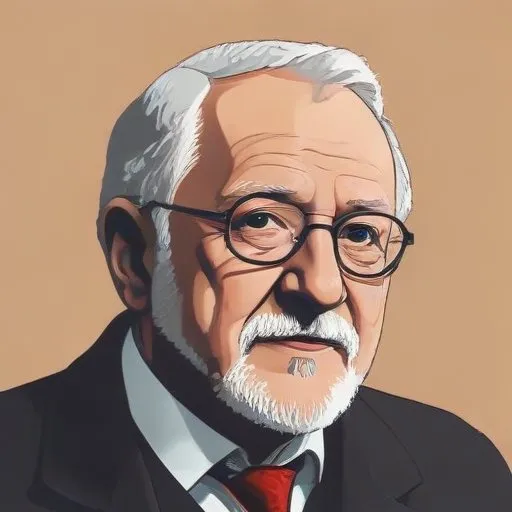
A prominent literary theorist and cultural critic, known for his influential works on Marxist theory, postmodernism, and literary criticism, offering provocative insights into the intersection of politics and culture.
Terry Eagleton, a luminary in the realm of literary theory and philosophy, is renowned for his provocative and incisive writings that have challenged the status quo in both academia and popular culture. His magnum opus, Literary Theory: An Introduction, has sold over 750,000 copies, cementing his reputation as a visionary thinker and critic.
Born on February 22, 1943, in Salford, Greater Manchester, England, Eagleton grew up in a working-class Catholic family of Irish descent. His maternal side had strong Irish republican sympathies, which likely shaped his early fascination with politics and social justice.
Eagleton has held prestigious professorships at the University of Oxford, University of Manchester, and Lancaster University, among others. His extensive bibliography boasts over 40 books, including The Illusions of Postmodernism (1996) and After Theory (2003), which critique the excesses of postmodernism and advocate for the importance of objectivity and ethics in cultural theory.
Eagleton's thought is deeply influenced by Marxism and Christianity, reflecting his commitment to social justice and the importance of critique in understanding the human condition. He argues that literary theory must be grounded in a nuanced understanding of politics, history, and culture, rather than mere fashionable intellectual posturing.
Eagleton's work has had a profound impact on modern society, shaping the discourse on literary theory, cultural criticism, and the role of intellectuals in public life. His critiques of postmodernism and its discontents have been influential in reevaluating the relationship between politics, culture, and ethics.
Known for his provocative style and willingness to challenge prevailing ideologies, Eagleton has been involved in various controversies, including publicly debating critics of religion and engaging with the New Atheist movement. His unflinching commitment to his beliefs has earned him both admiration and criticism.
Eagleton has received numerous awards and honors for his contributions to literary theory, philosophy, and cultural criticism. He has also been a visiting professor at esteemed institutions worldwide, sharing his insights with a new generation of scholars and thinkers.
In the annals of modern literary theory, Eagleton's work stands alongside that of influential thinkers such as Harold Bloom, Jacques Derrida, and Fredric Jameson. His unique blend of Marxism, Christianity, and literary critique has carved out a distinct niche in the intellectual landscape.
As Eagleton continues to write and engage with the intellectual community, his work is likely to remain a lightning rod for controversy and debate. His commitment to social justice, critical thinking, and the importance of critique will continue to inspire and challenge new generations of scholars and thinkers.
Born in 1889
A German philosopher and academic who explored the meaning of existence, time, and human existence, influencing 20th-century philosophy with his concept of "Being-in-the-world".
96 Years Old
A pioneer of poststructuralism, deconstructing traditional notions of meaning and challenging Western philosophy's core assumptions. His work redefined the way we think about language, culture, and identity.
92 Years Old
A prominent cultural critic and Marxist theorist, known for his work on postmodernism, capitalism, and the intersection of politics and culture.
77 Years Old
A contemporary philosopher and cultural critic, known for his provocative writings on ideology, capitalism, and popular culture, often blending Lacanian psychoanalysis with Marxist theory.
89 Years Old
A prominent contemporary philosopher and academic, known for developing the concept of "evental philosophy" and applying it to various fields, including politics, ethics, and aesthetics.
97 Years Old
A French sociologist and philosopher who developed theories on consumerism, hyperreality, and the simulation of reality, arguing that our postmodern world is more concerned with images and appearances than reality itself.
Born in 1915
A French philosopher, theorist, and critic who challenged traditional notions of culture, literature, and identity through his influential writings on semiotics, mythology, and structuralism. He's most known for his critical theories on modern society and culture.
99 Years Old
A French historian and philosopher who critiqued power structures and social norms, arguing that knowledge and truth are shaped by those in power. He's known for his concepts of power, discipline, and surveillance.
