


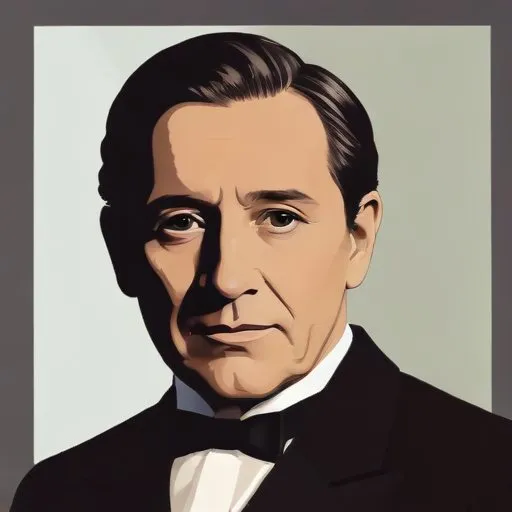
A pioneering composer and conductor who expanded the possibilities of orchestral music through innovative spatial arrangements and eclectic fusions of styles.
Henry Brant was a Canadian-born American composer known for his pioneering work in spatial music, a genre that exploits the placement of musicians and instruments in space to create an immersive sonic experience. His innovative compositions, often featuring unconventional instrumental combinations and orchestral arrangements, continue to inspire and challenge musicians and audiences alike.
Born on September 15, 1913, in Montreal, Canada, to American parents, Brant displayed a prodigious talent for music from an early age. He began composing at eight and went on to study at the McGill Conservatorium (1926-1929) and in New York City (1929-1934), where he honed his skills as a violinist, flutist, tin whistler, pianist, organist, and percussionist.
At 19, Brant was the youngest composer featured in Henry Cowell's landmark book, American Composers on American Music (1933). Cowell recognized Brant's early affinity with the American experimental musical tradition, showcasing his essay on oblique harmony, a concept that would later influence his spatial compositions.
Brant's versatility as a composer, orchestrator, and conductor led to collaborations with radio, film, ballet, and jazz groups. This stylistic diversity would later inform his mature output, characterized by experimentation and a willingness to push boundaries.
In the mid-1950s, Brant came to believe that traditional musical forms were insufficient to capture the complexities of modern life. He sought to create a new framework for music that could accommodate the simultaneity of multiple textures and styles. This quest led to a series of innovative compositions and experiments that explored the potential of spatial music.
Brant's teaching career spanned over two decades, with posts at Columbia University, the Juilliard School, and Bennington College, where he taught for 24 years. His students included American composer Patsy Rogers, ensuring the continuation of his spatial music legacy.
Some of Brant's most notable works include:
Brant received numerous awards and honors for his contributions to music, including three Guggenheim Fellowships and the National Medal of Arts (1996).
Henry Brant's innovative spirit, experimental approach, and commitment to redefining the boundaries of music continue to inspire generations of composers, musicians, and audiences. His legacy serves as a testament to the power of creativity and the importance of pushing the boundaries of artistic expression.
Through his work, Brant reminds us that music is a dynamic, multidimensional art form capable of evoking the complexities and contradictions of human experience. As we continue to navigate the complexities of modern life, Brant's spatial music offers a powerful framework for capturing the essence of our collective spirit.
84 Years Old
A visionary musician and producer who co-founded The Velvet Underground, pushing boundaries in rock music and influencing generations of artists. Known for experimental and avant-garde work .
Born in 1926
A pioneer of indeterminacy in music, creating subtle, atmospheric soundscapes that defy traditional composition, and teaching generations of musicians to think outside the box.
99 Years Old
Pioneering composer of avant-garde and experimental music, known for introducing indeterminacy and improvisation into classical music, creating a new language of sound.
Born in 1679
Developed a philosophical system that combined elements of Leibniz and Descartes, and was a prominent figure in the German Enlightenment. He wrote extensively on metaphysics, ethics, and logic.
97 Years Old
A pioneer of electronic and avant-garde music, this composer pushed boundaries with unconventional sounds and performances, influencing generations of musicians and artists.
Born in 1925
A renowned French musician who revolutionized classical music with his avant-garde compositions and innovative conducting style, pushing boundaries and redefining the genre.
Born in 1883
A pioneering composer who blended classical and modernist styles, creating innovative, avant-garde works that explored new sounds and techniques.
96 Years Old
A pioneer of avant-garde music, this composer and educator is renowned for his innovative and theatrical works that often feature unconventional instruments and techniques.
