


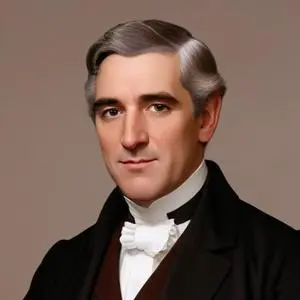
A Scottish lawyer and politician who served as Lord Chancellor of Great Britain, known for his advocacy of social and political reforms, particularly in the areas of education and slavery abolition.
Henry Brougham, 1st Baron Brougham and Vaux, is renowned for playing a pivotal role in passing two of the most significant acts in British history: the Reform Act of 1832 and the Slavery Abolition Act of 1833. As a British statesman, he devoted his life to pursuing liberal causes, including the abolition of the slave trade, free trade, and parliamentary reform.
Born on September 19, 1778, in Edinburgh, Scotland, Brougham was the eldest son of Henry Brougham and Eleanora Syme. He received his education at the Royal High School and the University of Edinburgh, where he developed a strong foundation in natural science, mathematics, and law. His academic pursuits led to the publication of several scientific papers through the Royal Society, notably on the topic of light.
In 1802, Brougham co-founded the Edinburgh Review, a publication that would become a bastion of progressive thought. He later moved to London, where he qualified as a barrister in 1808. His entry into politics came in 1810, when he was elected to the House of Commons as a Whig Member of Parliament. Brougham's exceptional oratory skills and commitment to liberal causes quickly earned him recognition, and he became a prominent figure in British politics.
Brougham's greatest achievements came during his tenure as Lord Chancellor from 1830 to 1834. He played a crucial role in passing the Reform Act of 1832, which aimed to reduce corruption and increase representation in Parliament. Additionally, he advocated for the abolition of slavery, ultimately contributing to the passage of the Slavery Abolition Act of 1833. These landmark reforms cemented Brougham's status as a champion of social justice.
Brougham's passion for education led to his involvement in the establishment of the Society for the Diffusion of Useful Knowledge and University College London. He also held academic posts, including the position of Rector at the University of Edinburgh. These endeavors reflect his dedication to making education accessible to a broader audience.
In his later years, Brougham spent much of his time in Cannes, France, where he popularized the town as a resort for the British upper classes. He passed away on May 7, 1868, leaving behind a legacy as a devoted reformer, abolitionist, and advocate for education.
Brougham was known for his exceptional oratory skills, as well as his unwavering commitment to liberal causes. One of his most famous quotes, "Education makes a people easy to lead, but difficult to drive: easy to govern, but impossible to enslave," reflects his deep understanding of the power of knowledge and education.
Through his remarkable life and achievements, Henry Brougham, 1st Baron Brougham and Vaux, left an indelible mark on British history, paving the way for future generations of reformers and abolitionists.
Born in 1788
Romantic poet and playwright celebrated for passionate, expressive works that explored themes of love, freedom, and the human condition.
Born in 1770
A skilled lawyer and politician who served as Prime Minister of the United Kingdom, known for his strong oratory skills and brief but influential tenure in office.
Born in 1762
The only British Prime Minister to be assassinated, he served from 1809 to 1812 and is known for his strong leadership during the Napoleonic Wars.
Born in 1759
Prime Minister of the United Kingdom from 1783 to 1801 and 1804 to 1806, known for leading the country through the French Revolutionary and Napoleonic Wars.
Born in 1749
A prominent 18th-century politician who championed individual liberties and opposed British imperialism, known for his charismatic oratory skills and influential foreign policy decisions.
Born in 1759
A British abolitionist who led the movement to end the slave trade in the UK, playing a key role in passing the Slave Trade Act of 1807.
