


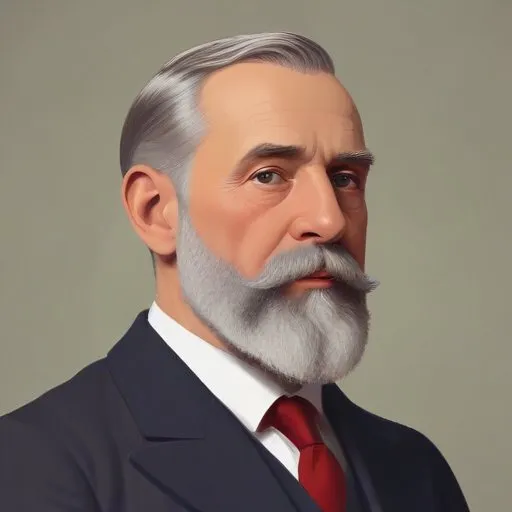
A wealthy industrialist and philanthropist who played a key role in the development of the American steel industry, and was a major benefactor of the arts and education.
Henry Clay Frick was a renowned American industrialist, financier, and art patron, best known for his role in the formation of the U.S. Steel manufacturing concern and his extensive collection of old master paintings and fine furniture, now housed in the celebrated Frick Collection and art museum.
Born on December 19, 1849, in West Overton, Westmoreland County, Pennsylvania, Frick was a grandson of Abraham Overholt Oberholzer, the owner of the prosperous Overholt Whiskey distillery. His father, John W. Frick, was of Swiss ancestry, while his mother was of German ancestry.
Frick attended Otterbein College for one year but did not graduate. In 1871, at just 21 years old, he joined two cousins and a friend in a small partnership, using a beehive oven to turn coal into coke for use in steel manufacturing. This marked the beginning of his ascending career, as he vowed to become a millionaire by the age of thirty.
Thanks to loans from the family of lifelong friend Andrew Mellon, by 1880, Frick bought out his partnership and renamed the company H. C. Frick Company. The company employed 1,000 workers and controlled 80 percent of the coal output in Pennsylvania, operating coal mines in Westmoreland and Fayette counties.
Frick's business acumen and strategic partnerships led to his becoming chairman of the Carnegie Steel Company, and later, a key figure in the formation of the giant U.S. Steel manufacturing concern.
Aside from his industrial pursuits, Frick was an avid art collector and patron. Upon his death, he donated his extensive collection of old master paintings and fine furniture to create the celebrated Frick Collection and art museum.
The Frick Collection features an impressive array of works by European masters, including Rembrandt, Vermeer, and Whistler, among others. The museum, housed in Frick's former Neoclassical mansion in Manhattan, is now a U.S. National Historic Landmark.
Despite his many accomplishments, Frick's legacy is not without controversy. As a founding member of the South Fork Fishing and Hunting Club, he was in large part responsible for the alterations to the South Fork Dam that caused its catastrophic failure, leading to the Johnstown Flood.
Frick's vehement opposition to unions also led to violent conflict, most notably in the Homestead Strike. His legacy serves as a reminder of the complex and often fraught nature of industrialization and labor relations.
Frick's contributions to the steel industry and his role in shaping the American industrial landscape are undeniable. His philanthropic efforts, particularly in the realm of art, have left an enduring legacy that continues to inspire and educate generations.
Today, the Frick Collection remains a testament to Frick's passion for art and his commitment to preserving cultural heritage. As a complex and multifaceted figure, Henry Clay Frick's life and achievements continue to fascinate and instruct us about the complexities of industrialization, labor relations, and the power of art to transcend time.
Born in 1835
A self-made industrialist who amassed a vast fortune in the steel industry, then donated most of it to fund over 2,500 public libraries and other philanthropic endeavors.
Born in 1839
Founded the Standard Oil Company, revolutionizing the oil industry and amassing vast wealth, which he later used for philanthropic efforts. He's remembered for his business acumen and generosity.
Born in 1837
Founded a powerful banking dynasty and dominated corporate finance, shaping the American economy through strategic investments and mergers.
Born in 1794
Built railroad empires, revolutionizing transportation and commerce, and donated extensively to education and the arts.
Born in 1848
A pioneer in the railroad industry, he transformed transportation in the United States through strategic investments and innovative management practices. His philanthropic efforts also supported conservation and education initiatives.
Born in 1863
Founded the pioneering automobile manufacturing company that revolutionized the industry with the assembly line production method, making cars more affordable and accessible to the masses.
Born in 1763
A German-American mogul who built a fur trading empire and invested in real estate, amassing a vast fortune, which he later used to support the arts and education.
Born in 1836
A ruthless and cunning financier who dominated the railroad industry in the late 19th century, known for his clever business tactics and questionable ethics.
