


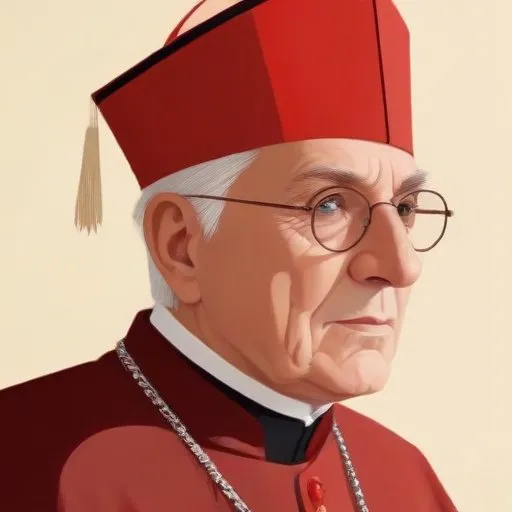
A prominent Catholic cleric who played a key role in shaping the Church's social and political stance in 19th-century England, particularly regarding labor rights and education.
Henry Edward Manning is best known as the second Archbishop of Westminster, a prominent figure in the Catholic Church, and a leading convert from Anglicanism. Born on July 15, 1808, Manning played a significant role in shaping the Catholic Church in England during the 19th century, leaving a lasting legacy in the world of religion.
Manning was born at Copped Hall, Totteridge, Hertfordshire, to a prominent merchant and slave owner, William Manning, and Mary Hunter. He spent his boyhood at Coombe Bank, Sundridge, Kent, where he formed close friendships with Charles and Christopher Wordsworth, who would later become bishops.
Initially, Manning had ambitions of a political career, but his father's business losses led him to pursue a clerical career under Evangelical influences. He resigned from his position as a supernumerary clerk in the Colonial Office in 1832 and began to explore his faith.
In 1851, Manning converted to Catholicism, largely due to the Gorham judgment, which led him to question the authority of the Church of England. This conversion was met with opposition from his family and friends, but Manning remained resolute in his decision.
In 1865, Manning was appointed as the second Archbishop of Westminster, a position he held until his death in 1892. During his tenure, he worked tirelessly to promote Catholicism in England, establish Catholic schools, and advocate for the rights of the poor and marginalized.
Manning was a strong advocate for social justice and believed in the importance of education and charitable works. He was also a vocal critic of liberalism and the concept of laissez-faire, arguing that the state had a responsibility to protect the vulnerable and promote the common good.
Henry Edward Manning left an indelible mark on the Catholic Church in England and beyond. His commitment to social justice, education, and charitable works continues to inspire generations of Catholics and non-Catholics alike. Despite facing opposition and criticism throughout his life, Manning remained true to his convictions, earning him a place as one of the most significant figures in Catholic history.
"The glory of God is the only solid foundation of all true greatness."
Manning's legacy serves as a testament to the power of faith, conviction, and compassion, inspiring us to work towards a more just and equitable society.
Born in 1499
Reigned from 1559 to 1565, this Pope oversaw the final session of the Council of Trent, shaping Catholic doctrine and practice for centuries to come. He also commissioned the construction of the Sistine Chapel's dome.
Born in 1810
The first pope to fully embrace modernity, he issued the groundbreaking encyclical Rerum Novarum, which addressed social justice and workers' rights, shaping the Catholic Church's stance on social issues.
Born in 1801
A leading figure in the Oxford Movement, he was a prominent theologian and philosopher who converted to Catholicism, influencing Christian thought and education. He's also known for his poetry and hymns.
Born in 1478
A renowned Renaissance humanist and statesman who served as Lord Chancellor of England, famous for his literary work "Utopia" and his martyrdom for refusing to acknowledge the English monarch's supremacy over the Church.
Born in 1542
A 16th-century theologian and doctor of the Church, known for his writings on spirituality and his role in shaping Catholic doctrine. He was a key figure in the Counter-Reformation, defending Catholicism against Protestantism.
Born in 1506
Co-founder of the Society of Jesus, a Catholic religious order, known for his missionary work in Asia, especially in India and Japan, and for his role in the Counter-Reformation. He's revered for his tireless efforts to spread Christianity and his compassion for the poor and marginalized.
Born in 1581
A 17th-century French priest dedicated his life to serving the poor and marginalized, establishing a congregation of priests and nuns to provide aid and comfort to those in need. He's revered for his selfless charity and compassion.
