


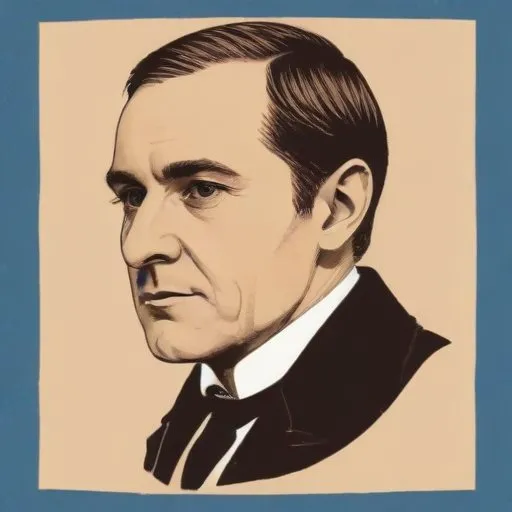
A Scottish physician and missionary who pioneered the use of fingerprinting as a means of identification, revolutionizing forensic science.
Henry Faulds, a Scottish doctor, missionary, and scientist, is renowned for his groundbreaking contribution to the development of fingerprinting, a technique that has become a cornerstone of modern forensic science. His pioneering work in this field has left an indelible mark on the history of criminology and has saved countless lives.
Born on June 1, 1843, in Beith, North Ayrshire, Scotland, Faulds hailed from a family of modest means. Forced to leave school at the tender age of 13, he worked as a clerk in Glasgow to support his family. However, his thirst for knowledge never wavered, and at 21, he enrolled at the Faculty of Arts at Glasgow University, where he studied mathematics, logic, and the classics.
Subsequently, Faulds pursued his passion for medicine at Anderson's College, graduating with a physician's license. This marked the beginning of his illustrious career as a medical missionary.
In 1873, Faulds received a letter of appointment from the United Presbyterian Church of Scotland to establish a medical mission in Japan. He married Isabella Wilson in September of the same year, and the couple set sail for Japan in December.
In Japan, Faulds established the first English-speaking mission in 1874, complete with a hospital and a teaching facility for Japanese medical students. He introduced Joseph Lister's antiseptic methods to Japanese surgeons, revolutionizing the country's medical landscape.
Faulds' fascination with fingerprints began during his time in Japan. His curiosity was sparked when he noticed the unique patterns on his patients' fingers. He started collecting fingerprints, experimenting with various methods to classify and identify them.
His work in fingerprinting led to the publication of a paper, "On the Skin-Furrows of the Hand," in the journal Nature in 1880. This landmark publication introduced the concept of fingerprinting to the scientific community, paving the way for its widespread adoption in the years to come.
Faulds' dedication to his work extended far beyond his scientific pursuits. He played a significant role in improving public health in Japan, helping to found the Rakuzenkai, Japan's first society for the blind, and establishing lifeguard stations to prevent drowning in nearby canals.
His humanitarian work continued to flourish, as he helped to halt a rabies epidemic and stopped the spread of cholera in Japan. Faulds' tireless efforts earned him immense respect and admiration from the Japanese people.
Honored for his contributions to science and humanity, Faulds was awarded the honorary degree of LL.D. from Glasgow University in 1922.
Today, Henry Faulds is remembered as a trailblazer in the field of fingerprinting, whose work has had a profound impact on modern forensic science. His legacy serves as a testament to the power of human ingenuity and dedication, inspiring generations to come.
Faulds' remarkable story serves as a beacon of inspiration, reminding us that even the most seemingly insignificant discoveries can have far-reaching consequences. As we continue to build upon his pioneering work, we are forever indebted to the contributions of this extraordinary Scottish doctor and scientist.
Born in 1822
Pioneering the concept of correlation and regression analysis, this statistician is renowned for developing the field of biostatistics and introducing the idea of inherited intelligence.
Born in 1868
Discovered blood types and developed a system for classifying them, revolutionizing blood transfusions and saving countless lives. Pioneering work in immunology and serology also shed light on disease mechanisms.
Born in 1901
A pioneer in nuclear physics, known for leading the team that developed the first nuclear reactor and playing a crucial role in the development of the atomic bomb.
Born in 1791
A pioneer in computer science, credited with inventing the first mechanical computer, the Difference Engine, and conceptualizing the Analytical Engine, a precursor to modern computers.
