


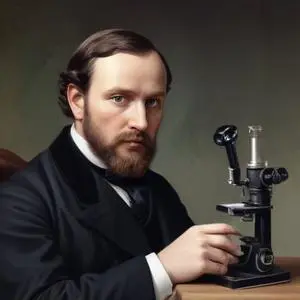
Pioneering antiseptic surgery, revolutionizing medical practices with germ-killing techniques, saving countless lives.
Joseph Lister, a British surgeon and medical scientist, revolutionized the craft of surgery by introducing antiseptic practices, transforming the way surgical procedures were performed. His groundbreaking work led to a significant reduction in postoperative infections, making surgery safer for patients and earning him the title of the "Father of Modern Surgery."
Joseph Lister was born on April 5, 1827, in Upton, England, to a Quaker family. His father, Joseph Jackson Lister, was a gentleman scientist and wine merchant, and his mother, Isabella Harris Lister, was a school assistant. Lister was the fourth child and second son of seven children. He received his early education at home before attending University College London, where he studied medicine.
Lister's most significant contribution to the field of surgery was the introduction of antiseptic practices. He was inspired by Louis Pasteur's germ theory of fermentation and realized that microorganisms were responsible for wound infections. To combat this, Lister introduced the use of carbolic acid (modern-day phenol) as a sterilizer for surgical instruments, patient's skin, sutures, surgeons' hands, and wards. This innovation led to a dramatic reduction in postoperative infections and drastically improved patient outcomes.
Lister's work in bacteriology and infection in wounds raised his operative technique to a new level, revolutionizing surgery worldwide.
He researched the role of inflammation and tissue perfusion in the healing of wounds, advancing diagnostic science.
He analyzed specimens using microscopes, promoting the principle of antiseptics.
He devised strategies to increase the chances of survival after surgery, further improving patient care.
Lister's groundbreaking work was recognized with numerous awards and honors, including:
Baronetcy in 1883
Fellow of the Royal Society (FRS) in 1860
Royal Medal in 1873
Copley Medal in 1902
Joseph Lister's work had a profound impact on modern surgery, transforming the way operations were performed and saving countless lives. His legacy extends beyond the medical community, influencing public health policies and shaping the future of healthcare. Today, Lister is remembered as a pioneer in antiseptic surgery, and his contributions continue to inspire generations of medical professionals.
In 1856, Lister married Agnes Syme, and the couple had no children. Lister was a humble and kind-hearted individual, known for his dedication to his patients and his profession. He died on February 10, 1912, at the age of 84, leaving behind a legacy that continues to shape the world of medicine.
Lister was a talented microscopist and made significant contributions to the field of microscopy.
He was a strong advocate for the importance of hand washing in surgical settings.
Lister's work was initially met with skepticism, but he persevered, and his findings eventually became widely accepted.
"The consequences of neglecting to adopt antiseptic precautions are too serious to be overlooked."
"It is our duty to remember that the patient is a sacred trust, and that we are responsible for his life and health."
"The greatest stimulus to progress is the spirit of criticism."
Born in 1820
Pioneering nurse and statistician who revolutionized healthcare by introducing sanitation practices and data-driven decision making, becoming the founder of modern nursing.
Born in 1822
Developed vaccines for rabies and anthrax, and pioneered the germ theory of disease, revolutionizing our understanding of microbiology and disease prevention.
Born in 1843
A pioneering microbiologist and physician who discovered the bacteria that cause tuberculosis, cholera, and anthrax, revolutionizing the field of microbiology and saving countless lives.
Born in 1749
Developed the smallpox vaccine, revolutionizing disease prevention and saving countless lives.
Born in 1881
Discovered penicillin, a revolutionary antibiotic, and pioneered its use in medicine. This breakthrough has saved countless lives and transformed the field of healthcare.
Born in 1914
Developed the first inactivated poliovirus vaccine, leading to the near eradication of polio, and founded the Salk Institute for Biological Studies.
Born in 1749
Developed the smallpox vaccine, revolutionizing disease prevention and saving countless lives.
Born in 1849
A Russian physiologist and physician who discovered the concept of classical conditioning, where he demonstrated that animals can learn to associate stimuli with a particular response, revolutionizing our understanding of behavior. His work laid the foundation for behavioral psychology and continues to influence fields like education and advertising.
