


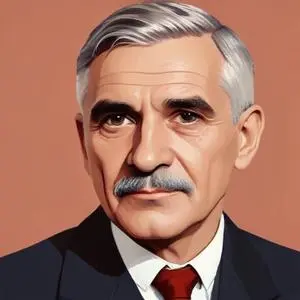
Discovered blood types and developed a system for classifying them, revolutionizing blood transfusions and saving countless lives. Pioneering work in immunology and serology also shed light on disease mechanisms.
Karl Landsteiner, an Austrian-American biologist, physician, and immunologist, is renowned for his groundbreaking discovery of the main blood groups in 1900, revolutionizing the field of transfusion medicine. His pioneering work enabled physicians to transfuse blood without endangering the patient's life, earning him the Nobel Prize in Physiology or Medicine in 1930.
Landsteiner was born on June 14, 1868, in Vienna, Austria, to a Jewish family. His father, Leopold Landsteiner, a prominent journalist and editor-in-chief of Die Presse, passed away when Karl was just six years old. He developed a strong bond with his mother, Fanny (née Hess). After completing his secondary education, Landsteiner pursued a degree in medicine at the University of Vienna, where he wrote his doctoral thesis in 1891.
Landsteiner's research career spanned several decades, during which he made significant contributions to the fields of immunology, virology, and medicine. His early work focused on the influence of diets on blood composition, and he published several papers on this topic while still a student. Between 1891 and 1893, he studied chemistry under prominent scientists such as Hermann Emil Fischer and Arthur Rudolf Hantzsch.
In 1909, Landsteiner, along with Constantin Levaditi and Erwin Popper, discovered the polio virus, a landmark finding that paved the way for further research into the causes and prevention of polio.
In 1937, Landsteiner, in collaboration with Alexander S. Wiener, identified the Rhesus factor, a critical discovery that enabled the safe transfusion of blood between individuals with different blood types.
Landsteiner's contributions to medicine and science were recognized with numerous awards and honors, including the Aronson Prize in 1926, the Nobel Prize in Physiology or Medicine in 1930, and the Lasker Award in 1946.
Karl Landsteiner's pioneering work in transfusion medicine has had a profound impact on modern medicine. His discovery of the main blood groups and the Rhesus factor has saved countless lives and enabled the widespread use of blood transfusions in medical practice. Today, he is remembered as the father of transfusion medicine, and his work continues to inspire new generations of scientists and medical professionals.
Landsteiner emigrated to New York in 1923, at the age of 55, in search of new professional opportunities. He worked at the Rockefeller Institute, where he continued to conduct research and make significant contributions to the field of medicine.
"The blood is the life," Landsteiner once remarked, emphasizing the critical importance of blood transfusions in medical practice.
Landsteiner's work was set against the backdrop of significant advances in medicine and science during the late 19th and early 20th centuries. His discoveries built upon the work of other prominent scientists, such as Emil Fischer and Max von Gruber, and paved the way for future breakthroughs in the fields of immunology and virology.
Landsteiner's work can be compared to that of other prominent scientists of his time, such as Emil von Behring and Shibasaburo Kitasato, who made significant contributions to the fields of immunology and medicine.
Landsteiner's discoveries have had a profound impact on modern society, enabling the widespread use of blood transfusions in medical practice and saving countless lives. His work continues to inspire new generations of scientists and medical professionals, and his legacy is a testament to the power of scientific inquiry and discovery.
Born in 1881
Discovered penicillin, a revolutionary antibiotic, and pioneered its use in medicine. This breakthrough has saved countless lives and transformed the field of healthcare.
Born in 1898
A high-ranking officer in the German Wehrmacht during World War II, known for his involvement in the July 20 plot to assassinate Adolf Hitler.
Born in 1918
Pioneering biochemist who discovered the mechanism of DNA replication and was awarded the Nobel Prize in Physiology or Medicine in 1959 for his groundbreaking work on nucleic acid synthesis.
Born in 1905
A pioneering biochemist who discovered the mechanism of RNA synthesis, earning a Nobel Prize in Physiology or Medicine in 1959. His work laid the foundation for our understanding of genetic code and protein synthesis.
Born in 1920
A French biologist and geneticist who discovered the mechanism of gene regulation, pioneering the field of molecular biology. He won the Nobel Prize in Physiology or Medicine in 1965 for his work on the genetic control of enzyme synthesis.
Born in 1910
A French biochemist and geneticist who discovered the mechanism of gene regulation, earning a Nobel Prize in Physiology or Medicine in 1965. He's also known for his book "Chance and Necessity," which explores the philosophical implications of modern biology.
