


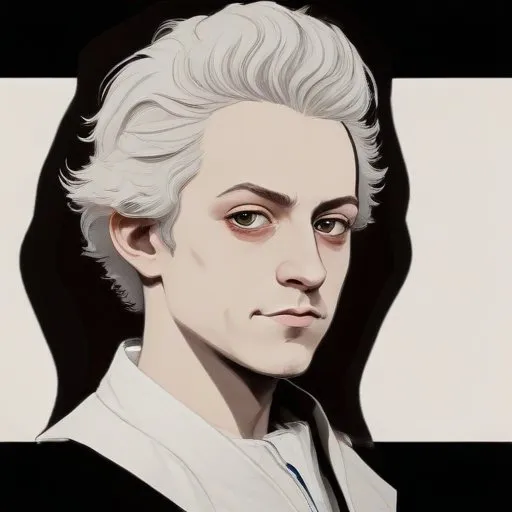
A Romantic-era artist celebrated for his dark, fantastical, and emotionally charged paintings that explored the human psyche, often blurring the lines between reality and myth.
Henry Fuseli is widely recognized as one of the most influential artists of the 18th century, renowned for his eerie and fantastical depictions of supernatural experiences. His iconic painting, The Nightmare, has become an emblem of the darker aspects of human imagination, cementing Fuseli's reputation as a master of the macabre.
Born Johann Heinrich Füssli on February 7, 1741, in Zürich, Switzerland, Fuseli was the second of 18 children. His father, a painter and author, intended for him to enter the church, and Fuseli received a classical education at the Caroline college of Zürich. However, his artistic talent soon prevailed, and he pursued a career in art instead.
In 1765, Fuseli traveled to England, where he became acquainted with Sir Joshua Reynolds, who advised him to devote himself entirely to art. This guidance led Fuseli to embark on an artistic pilgrimage to Italy, where he remained from 1770 to 1778, adopting the more Italian-sounding surname Fuseli.
Fuseli's talent and reputation earned him numerous accolades, including the position of Professor of Painting and Keeper at the Royal Academy. He also received commissions from prominent patrons, such as Alderman Boydell, for whom he painted works for the Shakespeare Gallery.
Fuseli's art often explored the realms of the irrational and the unknown, reflecting his fascination with the human psyche and the mysteries of the universe. His work embodied a sense of Romantic idealism, emphasizing the power of imagination and the importance of individual creativity.
Henry Fuseli's innovative style, imaginative vision, and profound influence on modern art have solidified his position as a master of the macabre. His work continues to inspire and haunt audiences, ensuring his legacy as one of the most fascinating and enigmatic artists of all time.
Born in 1741
A pioneering female artist of the 18th century, known for her exquisite portraits and landscapes that blended Neoclassicism with Rococo elements. Her work adorned the walls of European aristocracy and royalty.
Born in 1749
A German literary giant who penned iconic works like "Faust" and "The Sorrows of Young Werther", shaping the Romantic movement and influencing countless writers.
Born in 1744
A German Enlightenment thinker who shaped modern philosophy, literature, and anthropology with his ideas on cultural relativism, nationalism, and the importance of folklore. He's often considered the father of comparative literature.
Born in 1724
A leading figure of the German Enlightenment, he's credited with creating the first German epic poem, "Der Messias", which revolutionized German literature. His works inspired a new era of poetic expression.
Born in 1717
A pioneer in art history and archaeology, he's credited with founding the discipline of art history and shaping our understanding of ancient Greek and Roman art and culture.
Born in 1728
A prominent artist of the Neoclassicism movement, known for his elegant and harmonious style, which influenced the development of 18th-century art. He also wrote about aesthetics and art theory.
