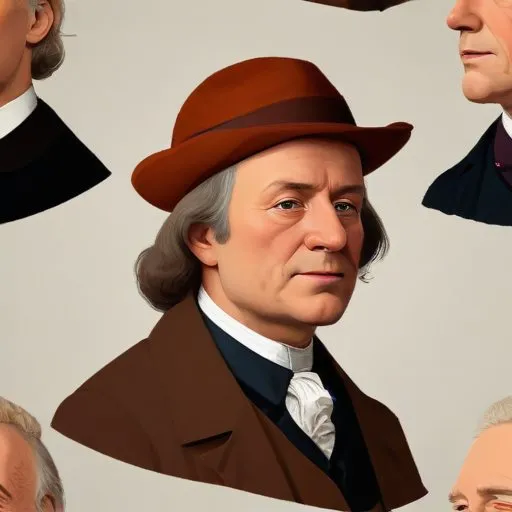
Johann Joachim Winckelmann: The Founding Father of Art History
A Pioneer in the Field of Art History and Archaeology
Johann Joachim Winckelmann is renowned for being the pioneer who first articulated the differences between Greek, Greco-Roman, and Roman art, thereby establishing himself as the father of the discipline of art history. His groundbreaking work laid the foundation for the scientific study of art history, and his influence on the rise of the Neoclassical movement during the late 18th century is still felt today.
Early Life and Education
Born in poverty on December 9, 1717, in Stendal, Margraviate of Brandenburg, Winckelmann's humble beginnings did not deter him from pursuing his passion for learning. His father, Martin Winckelmann, was a cobbler, and his mother, Anna Maria Meyer, was the daughter of a weaver. Despite the financial constraints, Winckelmann's intellectual curiosity drove him to study theology at the University of Halle, where he developed a deep appreciation for classical antiquity.
The Genesis of Art History as a Discipline
Winckelmann's seminal work,
Reflections on the Painting and Sculpture of the Greeks (1755), marked a turning point in the development of art history as a discipline. In this treatise, he introduced the concept of style as a means of categorizing art historically, thereby establishing a systematic approach to the study of art. This innovative methodology enabled Winckelmann to separate Greek art into distinct periods, a feat that had not been achieved before.
Philosophical Contributions and Beliefs
Winckelmann's philosophical inclinations leaned towards the ideals of classical antiquity, which he believed embodied the pinnacle of human achievement. He was particularly drawn to the concept of beauty, which he saw as an eternal and unchanging ideal. This notion is reflected in his famous dictum, "The supreme law of art is the representation of beauty."
Influence on Modern Society
The profound impact of Winckelmann's work on modern society is multifaceted. His writings influenced not only the development of archaeology and art history but also Western painting, sculpture, literature, and philosophy. The Neoclassical movement, which emerged in the late 18th century, was heavily indebted to Winckelmann's ideas, and his influence can be seen in the works of artists, writers, and thinkers such as
Gotthold Ephraim Lessing,
Johann Gottfried Herder,
Johann Wolfgang von Goethe, Friedrich Hölderlin,
Heinrich Heine,
Friedrich Nietzsche,
Stefan George, and
Oswald Spengler.
Personal Milestones and Key Life Events
Winckelmann's life was marked by several significant events that shaped his intellectual trajectory. In 1755, he was appointed as a librarian to Cardinal Alessandro Albani, which provided him with access to a vast collection of classical texts and artifacts. This appointment enabled him to pursue his research and writing, ultimately leading to the publication of his magnum opus,
History of Ancient Art (1764).
Controversies and Public Perception
Winckelmann's open homosexuality, which was recognized by his contemporaries, including Goethe, has been the subject of much speculation and debate. His artistic and intellectual circle, which included many prominent figures of the time, was known for its homoerotic undertones, and Winckelmann's writings often alluded to the beauty and allure of male bodies.
Tragic Demise and Legacy
On June 8, 1768, Winckelmann's life was brutally cut short when he was murdered by a fellow guest at his hotel in Trieste. The circumstances surrounding his death remain unclear, but his legacy as the founding father of art history continues to inspire generations of scholars, artists, and thinkers.
Historical Context and Legacy
Winckelmann's contributions to the field of art history are unparalleled, and his influence extends far beyond the realm of academia. His work has had a profound impact on Western cultural heritage, shaping the way we perceive and appreciate art, architecture, and aesthetics. As the prophet and founding hero of modern archaeology, Winckelmann's legacy continues to inspire and educate, ensuring that his relevance endures long after his tragic demise.