


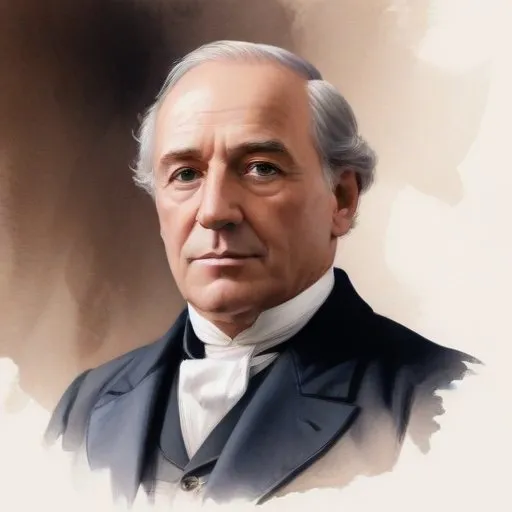
A prominent Union general during the American Civil War, he played a crucial role in the war's western theater and later served as General-in-Chief of all Union armies. He's also known for his scholarly writings on international law.
Henry Wager Halleck, affectionately known as "Old Brains," was a prominent figure in the American Civil War, renowned for his exceptional administrative and logistical prowess. As a senior United States Army officer, scholar, and lawyer, Halleck played a crucial role in shaping the Union's military strategy, earning him the reputation as a cautious and meticulous commander.
Born on January 16, 1815, in Westernville, New York, Halleck graduated from the United States Military Academy at West Point in 1839, ranking third in his class. He went on to pursue a career in law, earning a degree from Harvard Law School in 1859.
Halleck's military career spanned over three decades, with notable achievements in the Mexican-American War and the California Gold Rush. His expertise in military studies and mastery of logistics earned him the respect of his peers and superiors alike. In 1861, he was appointed as the commander of the Department of the Missouri, where he oversaw the Union's operations in the Western Theater.
In July 1862, following the failed Peninsula Campaign, Halleck was promoted to General-in-Chief of the Armies of the United States, a position he held until 1864. During his tenure, he implemented a series of reforms, centralizing command and improving communication between the War Department and field commanders. Although criticized for his cautious approach, Halleck's administrative skills and attention to detail helped to stabilize the Union's war effort.
Halleck's tenure as General-in-Chief was not without controversy. He clashed with several prominent generals, including Ulysses S. Grant and Don Carlos Buell, over issues of strategy and command. His cautious approach to battle, which emphasized defensive fortifications and thorough preparations, drew criticism from those who advocated for more aggressive action. Despite these criticisms, Halleck remained a respected figure in the military hierarchy, earning the nickname "Old Brains" for his cerebral approach to warfare.
Halleck's contributions to the Union's war effort were significant, if often overlooked. His mastery of logistics and administration helped to lay the groundwork for the ultimate defeat of the Confederacy. Although his cautious approach to battle may have limited his military achievements, his impact on the development of modern military strategy and organization remains undeniable. Halleck's legacy serves as a testament to the importance of careful planning and attention to detail in the pursuit of military victory.
Halleck married twice, first to Elizabeth Hamilton in 1855, and then to Caroline Asaeda McGowan in 1871. He died on January 9, 1872, at the age of 56, in Louisville, Kentucky. In his later years, Halleck devoted himself to writing and scholarship, producing several works on military history and strategy.
"The art of war is a science, and like all sciences, it requires study and experience to master it."
"The greatest mistake a commander can make is to act impulsively, without considering the consequences."
Born in 1822
Led the Union Army to victory in the Civil War and later became President, known for issuing the Emancipation Proclamation and strengthening federal authority.
Born in 1809
Led the United States through its Civil War and ultimately abolished slavery, leaving a lasting legacy in American history.
Born in 1820
A renowned Union general during the American Civil War, he's infamous for his scorched earth tactics and march through the Confederacy, leaving destruction in his wake.
Born in 1826
A Union general during the American Civil War, he's infamous for his cautious tactics and disagreements with President Lincoln, later becoming a governor of New Jersey.
Born in 1824
A Union general during the American Civil War, known for his distinctive sideburns and leading the Army of the Potomac to a disastrous defeat at the Battle of Fredericksburg.
Born in 1814
Union general who played a crucial role in the American Civil War, particularly at the Battle of Chancellorsville and Gettysburg.
Born in 1815
Led the Union Army to victory in the Battle of Gettysburg, a turning point in the American Civil War, and later oversaw the construction of the Washington Aqueduct.
Born in 1822
Union general during the American Civil War, known for his disastrous defeat at the Second Battle of Bull Run. He was relieved of his command and later served in the Indian Wars.
