


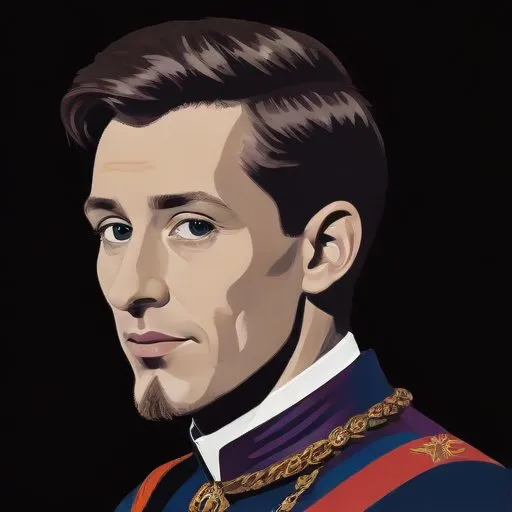
A powerful nobleman who led Lancastrian forces during the Wars of the Roses, known for his military prowess and loyalty to the Lancastrian cause.
Henry Holland, 3rd Duke of Exeter, born on June 27, 1430, was a prominent figure in the Wars of the Roses, a dynastic struggle for the English throne that ravaged the country from 1455 to 1485.
As the only son of John Holland, 2nd Duke of Exeter, and his first wife, Anne Stafford, Henry inherited the Dukedom of Exeter and the Earldom of Huntington upon his father's death in 1447.
Holland's temperament was marked by cruelty, savagery, and unpredictability, earning him a reputation as a dangerous and feared leader.
Contemporary Italian observers described him as fierce and cruel, and his lack of support was a direct result of his brutal nature.
During his tenure as Constable of the Tower of London, a notorious torture device, the "Duke of Exeter's daughter," was employed to extract confessions from prisoners.
In 1447, Holland married Anne, the eight-year-old daughter of Richard of York, but remained loyal to King Henry VI against the Yorkists during the Wars of the Roses.
Imprisoned at Wallingford Castle in 1455, Holland was later released and participated in the ill-fated "Love Day," a reconciliation attempt between rival factions.
Holland commanded the Lancastrian left flank at the Battle of Wakefield in 1460 and the Second Battle of St Albans in 1461, ultimately fleeing to Scotland after the Battle of Towton in 1461.
Exiled in France with Queen Margaret, Holland's estates were confiscated, and his wife divorced him in 1464.
During the brief restoration of King Henry VI, Holland regained some of his estates and posts, but his fortunes were short-lived.
At the Battle of Barnet, Holland was severely wounded and left for dead, only to survive and be imprisoned.
Later, he volunteered to serve on Edward IV's 1475 expedition to France, but fell overboard and drowned during the return voyage, bringing an end to his tumultuous life.
Holland's legacy is marked by his brutal nature and unwavering loyalty to the Lancastrian cause, despite his brief flirtation with the Yorkist faction.
His tumultuous career, marked by multiple imprisonments and reversals of fortune, serves as a testament to the treacherous landscape of the Wars of the Roses.
Born in 1340
A powerful and wealthy medieval English nobleman, known for his immense influence on English politics and his role in the Hundred Years' War. He was also a patron of the arts and a founder of Trinity College, Cambridge.
Born in 1367
The last king of the House of Plantagenet, deposed in a coup, known for his extravagance and tyranny, leading to his downfall and the rise of the Lancastrian dynasty.
Born in 1133
King of England from 1154 to 1189, known for establishing a strong centralized government, reforming the English church, and his tumultuous relationships with Thomas Becket and his sons.
Born in 1345
A member of the royal House of Lancaster, she was a patron of the arts and a powerful noblewoman who played a significant role in 14th-century English politics. Her legacy has endured through literature and art.
