


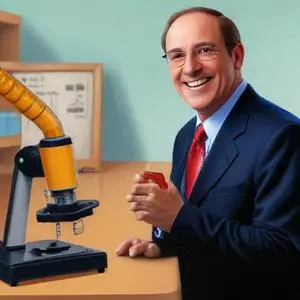
Co-founder of Genentech, a pioneer in genetic engineering, revolutionizing biotechnology and medicine through groundbreaking DNA research and development.
Herbert Boyer, an American biotechnologist, researcher, and entrepreneur, is renowned for his groundbreaking discovery that enabled bacteria to produce foreign proteins, revolutionizing the field of genetic engineering. Alongside Stanley N. Cohen and Paul Berg, Boyer's pioneering work has had a profound impact on modern medicine, agriculture, and various other industries.
Born on July 10, 1936, in Derry, Pennsylvania, Boyer developed an early interest in biology and chemistry. He earned his bachelor's degree from Saint Vincent College in Latrobe, Pennsylvania, in 1958. The following year, he married his wife, Grace. Boyer then pursued his PhD at the University of Pittsburgh, graduating in 1963. During this period, he actively participated in the civil rights movement.
Boyer's postdoctoral work at Yale University, under the guidance of Professors Edward Adelberg and Bruce Carlton, laid the foundation for his future achievements. In 1969, he conducted studies on restriction enzymes of the E. coli bacterium, which exhibited useful properties. This research led to a crucial breakthrough: the ability to combine genes from bacteria with those from eukaryotes.
In 1976, Boyer founded Genentech, a biotechnology company, alongside venture capitalist Robert A. Swanson. This pioneering venture focused on developing genetically engineered products, including synthetic insulin and growth hormone. Boyer's innovative approach won out over rival companies, establishing Genentech as a leader in the field.
Boyer's contributions to science and entrepreneurship have been recognized with numerous awards and honors. He is a recipient of the 1990 National Medal of Science and the 1996 Lemelson-MIT Prize. His achievements have also earned him a place in the National Inventors Hall of Fame.
Herbert Boyer's work has far-reaching implications for various industries, including medicine, agriculture, and biotechnology. His discovery has enabled the production of life-saving medicines, such as synthetic insulin, and opened up new avenues for genetic research. Boyer's legacy continues to inspire scientists and entrepreneurs, shaping the future of genetic engineering and its applications.
Throughout his career, Boyer has demonstrated a strong commitment to education and social responsibility. He has taught at the University of California, San Francisco (UCSF) and served as a professor of biochemistry. Boyer has also been an advocate for social justice, participating in the civil rights movement during his PhD studies.
Herbert Boyer's pioneering work in genetic engineering has left an indelible mark on the scientific community. His discovery has opened doors to new possibilities in medicine, agriculture, and biotechnology. As a trailblazer, Boyer continues to inspire future generations of scientists and entrepreneurs, cementing his place in the annals of scientific history.
Through his remarkable journey, Boyer has demonstrated the power of innovation, perseverance, and social responsibility. As we look to the future, his legacy serves as a beacon, guiding us toward a brighter, more promising tomorrow.
Born in 1918
Pioneering biochemist who discovered the mechanism of DNA replication and was awarded the Nobel Prize in Physiology or Medicine in 1959 for his groundbreaking work on nucleic acid synthesis.
Born in 1922
A Nobel Prize-winning biochemist who discovered epidermal growth factor, a protein essential for cell growth and development, and pioneered the field of growth factor research.
90 Years Old
Co-founder of Genentech, a pioneer in genetic engineering, revolutionizing biotechnology and medicine through groundbreaking DNA research and development.
Born in 1926
A pioneer in genetic engineering, he discovered ways to combine DNA molecules from different organisms, leading to major breakthroughs in biotechnology and medicine.
92 Years Old
American captain, engineer, and astronaut who flew on the Apollo 17 mission, becoming one of the last humans to walk on the Moon, and conducted three EVAs.
