


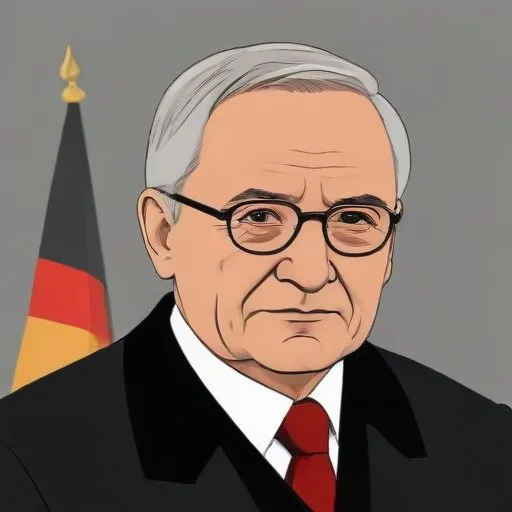
A key figure in post-WWII German politics, he played a crucial role in shaping the country's reunification efforts and served as a minister in the German government.
Known for his fiery rhetoric and unapologetic criticism, Herbert Wehner was a German politician who left an indelible mark on the country's post-war landscape. As a former member of the Communist Party and later a leading figure in the Social Democratic Party (SPD), Wehner's unwavering dedication to social justice and his unbridled passion for debate earned him a reputation as a force to be reckoned with in German politics.
Born on July 11, 1906, in Dresden, Wehner was raised in a family of modest means, with his father working as a shoemaker. His father's involvement in the trade union movement and the Social Democratic Party instilled in Wehner a sense of social responsibility from an early age. As a young man, Wehner became involved in anarchist and syndicalist circles, influenced by the likes of Erich Mühsam.
Wehner joined the Communist Party of Germany (KPD) in 1927, rising quickly through the ranks to become an official of the party's Rote Hilfe organization. However, with the rise of Hitler and the Nazi regime in 1933, Wehner was forced into exile, first in Paris and later in Moscow, where he lived at Hotel Lux and wrote for the Deutsche Zentral-Zeitung. During this period, he had to navigate the treacherous landscape of Stalin's Great Purge, which ultimately led to his disillusionment with communism.
After World War II, Wehner joined the Social Democratic Party (SPD) and quickly became a prominent figure in German politics. He served as Federal Minister of Intra-German Relations from 1966 to 1969 and later as chairman of the SPD parliamentary group in the Bundestag until 1983. Wehner's caustic rhetoric and heckling style, often directed at MPs with whom he disagreed, earned him a record 77 (or 78/79, depending on the source) official censures. Despite this, he remained a respected and influential voice in German politics, shaping the country's social and economic policies for decades.
Wehner's legacy is complex and multifaceted. His commitment to social justice and his unwavering dedication to the principles of democracy earned him the respect of his peers. However, his tumultuous relationships with his contemporaries and his willingness to engage in verbal sparring matches have also sparked controversy. Nevertheless, Wehner's impact on post-war Germany cannot be overstated, and his legacy continues to shape the country's political landscape to this day.
Wehner's life was a testament to his unwavering commitment to his principles, even in the face of adversity. His legacy serves as a reminder of the power of conviction and the importance of standing up for what one believes in, even when it means going against the status quo.
"Politics is not about making friends, it's about making a difference."
Wehner's life and career spanned some of the most tumultuous periods in German history. From the rise of the Nazi regime to the post-war reconstruction of Germany, Wehner played a significant role in shaping the country's political landscape. His legacy continues to influence German politics, with his commitment to social justice and democracy serving as a beacon for future generations of politicians.
Born in 1913
A German statesman who served as Chancellor of Germany, known for his efforts to reconcile with Eastern Europe and his "Ostpolitik" policy, earning him a Nobel Peace Prize.
Born in 1918
A German leader who served as Chancellor from 1974 to 1982, known for his pragmatic and socially liberal policies, and his key role in shaping the European Union. He was also a respected economist and published author.
82 Years Old
The 7th Chancellor of Germany, a lawyer-turned-politician, led the country from 1998 to 2005, implementing significant economic and social reforms. He's known for his efforts to modernize Germany and strengthen the European Union.
71 Years Old
The first female Chancellor of Germany, serving for 16 years, known for her leadership during the European sovereign-debt crisis and her role in shaping the European Union's policy. She's a highly influential figure in modern politics.
79 Years Old
German Minister of Finance from 2005 to 2009, known for his efforts to mitigate the effects of the global financial crisis and his role in shaping the European Union's economic policies.
66 Years Old
A German educator and politician who served as the 17th Vice-Chancellor of Germany, known for his efforts in promoting social democracy and European integration. He played a key role in shaping Germany's foreign policy and economy.
