


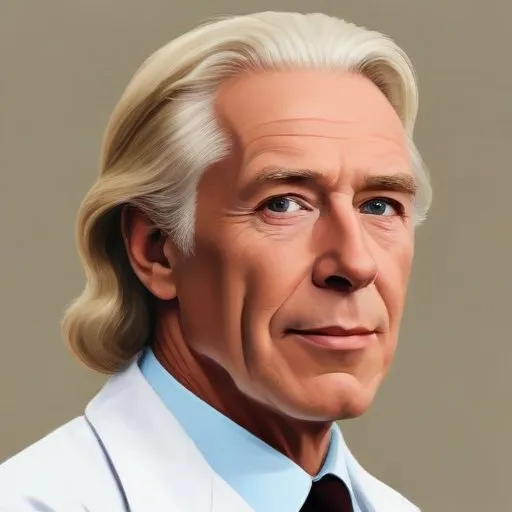
Developed a model of the alpha helix protein structure, a fundamental concept in biochemistry, and was a prominent African American scientist during the Civil Rights era.
Herman Russell Branson, a trailblazing American physicist and chemist, is renowned for his groundbreaking research on the alpha helix protein structure, a discovery that revolutionized our understanding of how proteins work and contribute to diseases such as sickle cell anemia. His remarkable contributions to the field of science have left an indelible mark on modern medicine and beyond.
Branson was born on August 14, 1914, and pursued his undergraduate degree in physics from Virginia State College, graduating in 1936. He then went on to earn his Ph.D. in physics from the University of Cincinnati in 1939, under the guidance of Boris Podolsky. His thesis, a comprehensive three-part work, delved into the interaction of X-rays with Tubifex tubifex, the design and construction of an X-ray intensity measuring device, and the quantization of mass using the Dirac Equation.
Branson's academic career spanned nearly three decades, with stints at Dillard University and Howard University, where he joined as an assistant professor of physics and chemistry in 1941. At Howard, he rose through the ranks, becoming the head of the physics department, director of a program in experimental science and mathematics, and working on projects funded by the Office of Naval Research and Atomic Energy Commission.
One of his most notable contributions was his work on protein structure, specifically the alpha helix. In 1948, he took a leave of absence to work at the California Institute of Technology, where he collaborated with the esteemed chemist Linus Pauling. Branson's mathematical prowess played a crucial role in narrowing down the possible structures to two helices, a tighter and looser version, which was instrumental in understanding protein function and its role in diseases.
Branson's legacy extends beyond his research. He mentored and inspired a generation of scientists, including Marie Maynard Daly, who became the first woman of color to earn a doctorate in chemistry in the United States. His commitment to education and mentorship has had a lasting impact on the scientific community.
Branson's contributions were recognized with a fellowship from the Rosenwald Foundation, a prestigious award that acknowledges outstanding achievements in the fields of science and education.
Throughout his life, Branson remained committed to education and research. He served as the president of two colleges, demonstrating his leadership skills and dedication to academia. His remarkable journey, marked by milestones and achievements, serves as an inspiration to aspiring scientists and scholars.
Branson's work on protein structure has far-reaching implications for modern medicine. His discovery of the alpha helix has led to a deeper understanding of protein function, enabling researchers to develop new treatments and therapies for diseases such as sickle cell anemia. His contributions have paved the way for advancements in medical research, disease diagnosis, and treatment.
Herman Branson's remarkable life and career serve as a testament to his dedication to science, education, and mentorship. His groundbreaking research on protein structure has left an indelible mark on modern medicine, and his legacy continues to inspire future generations of scientists and scholars.
Born in 1901
Pioneering chemist and peace activist who won two unshared Nobel Prizes, one for chemistry and one for peace, for his groundbreaking work on the nature of the chemical bond and his tireless efforts to promote nuclear disarmament.
Born in 1904
Leading the development of the atomic bomb during World War II, this brilliant mind made groundbreaking contributions to theoretical physics, pushing the boundaries of human understanding.
Born in 1901
A pioneer in nuclear physics, known for leading the team that developed the first nuclear reactor and playing a crucial role in the development of the atomic bomb.
Born in 1918
A brilliant physicist and engineer who pioneered quantum mechanics and famously explained complex concepts in simple terms, making science accessible to all.
Born in 1899
Developed quantum mechanics theories, including the concept of magnetism, and was awarded the Nobel Prize in Physics in 1977.
Born in 1902
A Hungarian physicist and mathematician who made groundbreaking contributions to quantum mechanics and nuclear physics, and was awarded the Nobel Prize in Physics in 1963.
Born in 1908
Developed the hydrogen bomb and was a key figure in the development of the US nuclear program, known for his advocacy of nuclear energy and his role in the Cold War.
