


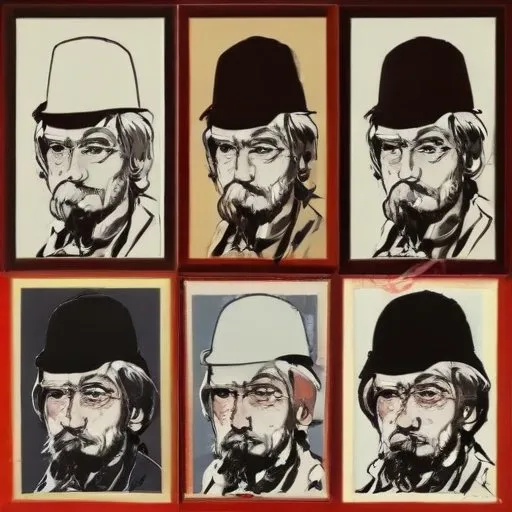
A medieval polymath who made significant contributions to music, mathematics, and astronomy, creating influential works on Gregorian chant and astronomical tables.
Hermann of Reichenau, also known as Hermann the Cripple, was a 11th-century Benedictine monk and scholar who left an indelible mark on the world of music, mathematics, astronomy, and literature. Despite being afflicted with a paralytic disease that rendered him immobile, Hermann's intellect and creativity knew no bounds, earning him recognition as one of the most prolific and influential thinkers of his time.
Born on July 18, 1013, Hermann was the son of the Count of Altshausen, but his early life was marked by physical limitations. He suffered from a cleft palate, cerebral palsy, and possibly amyotrophic lateral sclerosis or spinal muscular atrophy, which made it difficult for him to move and speak. Despite these challenges, Hermann's parents recognized his intellectual potential and placed him in the Benedictine monastery on Reichenau Island in Lake Constance, Germany, when he was just seven years old.
Within the monastery walls, Hermann flourished, developing a deep passion for theology, mathematics, music, and astronomy. He became an accomplished scribe, transcribing numerous manuscripts and creating his own works on various subjects. His treatises on music theory, mathematics, and astronomy showcased his remarkable understanding of the natural world and his ability to apply mathematical concepts to everyday life.
Hermann's musical compositions, including the iconic hymns Salve Regina, Veni Sancte Spiritus, and Alma Redemptoris Mater, are still celebrated today, although some attributions are disputed. His work in music theory, particularly his development of the Tonarius, a system for classifying chants, cemented his reputation as a pioneer in the field.
Hermann's incredible output and contributions to various fields earned him recognition from the Roman Catholic Church, which confirmed his cultus and beatification in 1863. His legacy extends beyond the church, as his work in mathematics, music, and astronomy influenced scholars for centuries, shaping the course of Western intellectual history.
Despite his physical limitations, Hermann's determination and intellectual curiosity inspired generations of scholars, monks, and thinkers. His story serves as a powerful reminder that human potential is not bound by physical constraints, but rather by the limitations we place on ourselves.
Hermann of Reichenau's remarkable life and achievements serve as a testament to the power of human ingenuity, creativity, and determination. Despite the physical limitations that could have defined him, Hermann's intellect and passion for knowledge left an indelible mark on the world, ensuring his legacy as one of the most fascinating and influential thinkers of the 11th century.
Born in 1459
A renowned organist and composer of the Renaissance era, known for his innovative and intricate compositions that showcased his mastery of the organ. He was a prominent figure in the development of the organ repertoire.
Born in 1819
Austrian composer and conductor renowned for his operettas, particularly "Light Cavalry" and "Poet and Peasant", which remain popular to this day.
Born in 1895
A renowned composer and educator, he's famous for his iconic cantata "Carmina Burana", which has become a cultural phenomenon, and his innovative approach to music education.
Born in 1908
A renowned organist, composer, and conductor, known for his innovative and expressive works for the organ, particularly his chorale preludes and partitas. His music is characterized by its lyricism, counterpoint, and rich harmony.
