


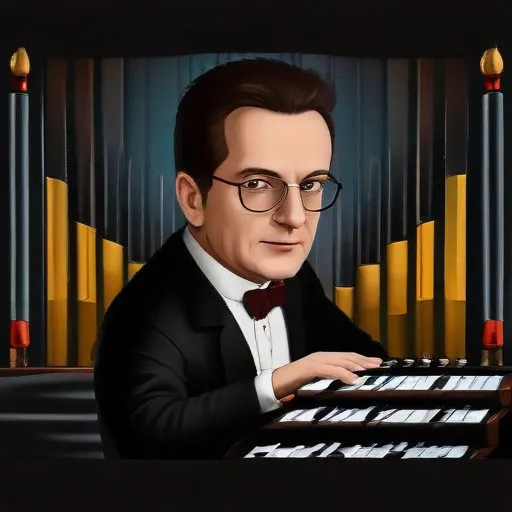
A renowned organist, composer, and conductor, known for his innovative and expressive works for the organ, particularly his chorale preludes and partitas. His music is characterized by its lyricism, counterpoint, and rich harmony.
Hugo Distler, a renowned German organist, choral conductor, and composer, left an indelible mark on the world of classical music. Known for his exquisite choral arrangements and organ compositions, Distler's music continues to resonate with audiences today, despite his untimely demise at the age of 34.
Born on June 24, 1908, in Nuremberg, Germany, Distler pursued his passion for music at the Leipzig Conservatory from 1927 to 1931. Initially, he focused on conducting, with piano as his secondary subject, but later shifted his attention to composition and organ under the guidance of his teacher.
In 1931, Distler became the organist at St. Jacobi in Lbeck, marking the beginning of his illustrious career. His talent and dedication earned him the position of head of the chamber music department at the Lbeck Conservatory in 1933. The same year, he married Waltraut Thienhaus and joined the National Socialist German Workers' Party (NSDAP), a decision that would later weigh heavily on his conscience.
Distler's teaching career took off in the late 1930s, with appointments at the Spandauer Kirchenmusikschule and the Wrttemberg Hochschule fr Musik in Stuttgart. During this period, he composed some of his most notable works, including choral pieces and organ compositions that showcased his unique style.
Distler's music was deeply rooted in his Christian faith, which often conflicted with the ideology of the Nazi regime. As he struggled to reconcile his artistic expression with the demands of the ruling party, Distler's music became a reflection of his inner turmoil.
On November 1, 1942, Distler took his own life, unable to cope with the constant threat of conscription, aerial attacks, and the moral implications of serving the Nazi regime. His suicide was a tragic consequence of his internal conflict, which had been building up over the years.
Despite his short life, Distler's compositions continue to inspire and influence generations of musicians and composers. His unique blend of traditional and modern elements has made his music timeless, and his legacy serves as a testament to the power of artistic expression in the face of adversity.
"I am not a politician, but an artist. I serve God, not the state."
Distler's life and work serve as a poignant reminder of the complexities and challenges faced by artists during times of political turmoil. His music remains a beacon of hope and resilience, transcending the boundaries of time and ideology.
Distler's unique style and compositions are often compared to those of his contemporaries, such as Hugo Wolf and Max Reger. While sharing similarities, Distler's music stands out for its innovative blend of traditional and modern elements.
Distler's marriage to Waltraut Thienhaus was a source of comfort and support during his tumultuous years. Their relationship served as a beacon of hope and normalcy in an era marked by uncertainty and chaos.
Distler's music continues to inspire and influence modern composers, conductors, and musicians. His legacy extends beyond the realm of classical music, serving as a testament to the power of artistic expression in the face of adversity.
Despite his untimely demise, Distler's contributions to music were recognized and celebrated during his lifetime. His music remains a testament to his artistic genius and dedication to his craft.
Distler's teaching career had a lasting impact on the development of choral music and organ composition. His students and contemporaries continued to build upon his legacy, ensuring that his influence extended beyond his own lifetime.
Hugo Distler's life and work serve as a powerful reminder of the importance of artistic expression, moral courage, and the enduring power of music. Despite the challenges he faced, Distler's legacy continues to inspire and influence generations of musicians and composers, ensuring that his music will live on forever.
Born in 1833
A renowned pianist and composer, he crafted complex, expressive works that blended traditional and innovative techniques, leaving an indelible mark on classical music.
Born in 1873
A renowned late Romantic composer, organist, and conductor, known for his prolific output of complex, intricate works that blended tradition with innovation.
Born in 1585
A renowned Baroque composer and organist, known for his contributions to the development of the oratorio and passion genres, creating over 500 works that showcased his mastery of choral music.
Born in 1685
A renowned Baroque composer and organist, famous for creating majestic orchestral suites, operas, and oratorios, including the iconic "Messiah" masterpiece.
Born in 1685
A master of Baroque music, he composed over 1,000 works, including orchestral suites, cantatas, and passions, that still inspire and influence musicians today. His innovative use of counterpoint and harmony raised the bar for classical music.
Born in 1809
A renowned 19th-century musician who masterfully blended classical and romantic styles, creating iconic works like the "Wedding March" and "Elijah" oratorio. His compositions continue to inspire and influence generations of artists.
Born in 1810
A renowned Romantic-era composer and influential music critic, known for his expressive and emotionally charged works, including symphonies, piano music, and art songs.
Born in 1895
A renowned composer and educator, he's famous for his iconic cantata "Carmina Burana", which has become a cultural phenomenon, and his innovative approach to music education.
