


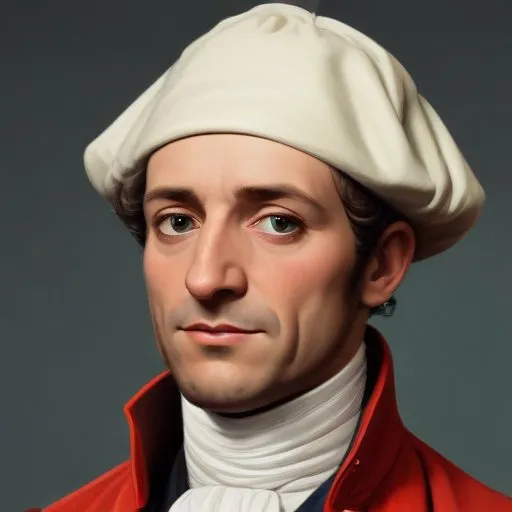
A French Romantic painter and lithographer, renowned for his vivid and detailed battle scenes, as well as his portraits of prominent military leaders.
Horace Vernet, a renowned French painter, is best known for his captivating battle scenes, portraits, and Orientalist subjects that showcased his unique style and artistic prowess. Born on June 30, 1789, in the Paris Louvre, Vernet's artistic trajectory was marked by a blend of innovative techniques, historical accuracy, and a disdain for the traditional academic French art.
Vernet's early career was marked by a desire to break free from the constraints of traditional French art, which was heavily influenced by Classicism. Instead, he opted to focus on contemporary life, depicting French soldiers in a more familiar, vernacular manner. His early works, such as "Taking of an Entrenched Camp" (1810), showcased his ability to capture the essence of modern warfare.
Vernet's battle paintings, commissioned by the Duc d'Orleans (later King Louis-Philippe), cemented his reputation as a master of historical accuracy and charged landscapes. His "Four Battles" series, which included "The Battle of Jemappes" (1821), "The Battle of Montmirail" (1822), "The Battle of Hanau" (1824), and "The Battle of Valmy" (1826), demonstrated his incredible speed and attention to detail.
In 1829, Vernet was appointed director of the French Academy in Rome, a position he held until 1835. During this period, he continued to receive numerous commissions and honours, solidifying his position as one of the most celebrated artists of his time.
Vernet's style was characterized by his use of bold colours, dynamic compositions, and a focus on capturing the human experience. His work was influenced by his father, Carle Vernet, and grandfather, Claude Joseph Vernet, who were both renowned artists. Vernet's unique approach blended the traditional with the modern, creating a style that was both innovative and authentic.
Vernet's personal life was marked by his relationships with prominent figures, including King Louis-Philippe and the Duc d'Orleans. He was known for his charm, wit, and generosity, which earned him the respect and admiration of his contemporaries. Vernet's legacy continues to inspire artists, historians, and art enthusiasts alike, with his works remaining a testament to his boundless creativity and artistic genius.
Horace Vernet's remarkable life and career serve as a testament to his innovative spirit, artistic genius, and dedication to capturing the essence of human experience. His works continue to inspire and educate, solidifying his position as one of the most celebrated artists of the 19th century.
Born in 1798
A Romantic-era master of expressive brushstrokes and vivid color, creating iconic works that captured the drama and emotion of historical and literary scenes.
Born in 1748
A French painter and illustrator who revolutionized Neoclassicism with his realistic and emotive works, creating iconic pieces like "Oath of the Horatii" and "Napoleon Crossing the Alps".
Born in 1770
A prominent Neoclassicist painter, renowned for his elegant and refined portraits of European aristocracy, capturing the essence of his subjects with precision and subtlety.
Born in 1771
A French Neoclassicist painter who created dramatic, emotionally charged scenes, often depicting Napoleon's military campaigns and heroic events. His works are characterized by vivid colors and intense lighting.
Born in 1780
A renowned French Neoclassicist painter and illustrator, celebrated for his exquisite portraits and historical scenes that epitomize elegance and refinement. His work continues to inspire artists and art enthusiasts alike.
Born in 1791
A Romantic-era master of dramatic and emotionally charged art, known for his powerful depictions of horses and the human experience.
Born in 1777
A French painter of portraits and historical scenes, known for his delicate and expressive style, which captured the essence of his subjects. He was a prominent artist during the French Revolution and Napoleon's reign.
