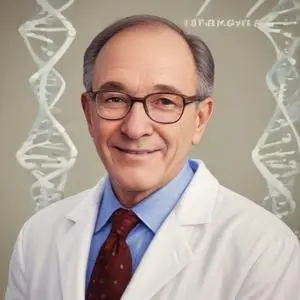
Howard Martin Temin

Howard Martin Temin

Howard Martin Temin was born on December 10th, 1934

Full Name: Howard Martin Temin
Nationality: American
Profession: Geneticist, Academic
Notable Work: Retrovirus research
Awards: Nobel Prize in Physiology or Medicine
Education: California Institute of Technology
Alma Mater: University of Wisconsin–Madison
Field of Study: Virology

Discovered the enzyme reverse transcriptase, which allows RNA to be converted into DNA, revolutionizing our understanding of genetic information. This breakthrough enabled the development of genetic engineering and gene therapy.

Written by: Emma Thompson Emma Thompson

Howard Martin Temin: The Pioneering Geneticist Behind Reverse Transcriptase

A Breakthrough Discovery in the Realm of Virology

Howard Martin Temin is renowned for his groundbreaking discovery of reverse transcriptase, a fundamental enzyme that revolutionized the field of virology. In the 1970s, Temin's pioneering work at the University of Wisconsin-Madison led to a deeper understanding of the retroviral life cycle, earning him the prestigious 1975 Nobel Prize in Physiology or Medicine, alongside Renato Dulbecco and David Baltimore.

Early Life and Education: A Foundation in Science

Born on December 10, 1934, in Philadelphia, Pennsylvania, Temin was raised in a family that valued social justice and independent thinking. His parents, Annette Lehman and Henry Temin, instilled in him a passion for learning, which was evident from an early age. As a high school student, Temin participated in the Jackson Laboratory's Summer Student Program in Bar Harbor, Maine, where he was recognized as an exceptional young scientist.

Under the guidance of C.C. Little, the director of the program, Temin's interest in science was sparked. Little's words of praise – "this boy is destined to become a really great man in the field of science" – proved prophetic, as Temin went on to excel in his academic pursuits.

Academic Achievements and Research

Temin earned his bachelor's degree from Swarthmore College in 1955, majoring and minoring in biology. He then pursued his doctorate degree in animal virology from the California Institute of Technology, graduating in 1960. It was during his time at Caltech that Temin was first exposed to experimental science in the laboratory of Professor Renato Dulbecco.

Initially, Temin studied embryology, but after a year and a half, he shifted his focus to animal virology, laying the groundwork for his future research.

Awards and Honors: Recognition for a Pioneering Discovery

Temin's groundbreaking discovery of reverse transcriptase earned him numerous accolades, including:

Legacy and Impact on Modern Science

Temin's work on reverse transcriptase has had a profound impact on our understanding of retroviruses and their life cycle. His discovery paved the way for significant advances in the fields of genetics, virology, and cancer research. Today, reverse transcriptase is a crucial tool in molecular biology, used to study and manipulate genetic sequences.

Temin's legacy extends beyond his scientific contributions, inspiring future generations of scientists to pursue careers in research and discovery.

Personal Milestones and Key Life Events

Temin's commitment to social justice and independent thinking was evident throughout his life. In keeping with his family's values, he donated the money that would have been spent on his bar mitzvah party to a local camp for displaced persons.

In his valedictorian speech, Temin addressed relevant issues of the time, including the hydrogen bomb activity and the prospect of sending a man to the moon.

A Lasting Impact on Virology and Beyond

Howard Martin Temin's pioneering work on reverse transcriptase has left an indelible mark on the scientific community. His groundbreaking discovery has far-reaching implications, influencing our understanding of genetics, virology, and cancer research. As we continue to build upon Temin's foundational work, his legacy serves as a testament to the power of human ingenuity and curiosity.
Timeline
1934
Born in Philadelphia
Howard Martin Temin was born on December 10, 1934, in Philadelphia, Pennsylvania. He would go on to become a renowned geneticist.
1959
Earned Ph.D.
Temin earned his Ph.D. in biochemistry from the University of Wisconsin–Madison in 1959, beginning his research career.
1970
Discovered Reverse Transcriptase
Temin, along with David Baltimore, discovered the enzyme reverse transcriptase in 1970, a groundbreaking finding in genetics.
1975
Nobel Prize in Physiology
Temin was awarded the Nobel Prize in Physiology or Medicine in 1975 for his discovery of reverse transcriptase.
1994
Died in Wisconsin
Temin passed away on February 9, 1994, in Wisconsin, leaving behind a legacy of significant scientific contributions.
Howard Martin Temin

Howard Martin Temin Quiz

What is the significance of the enzyme reverse transcriptase discovered by Howard Martin Temin?

Score: 0/5
FAQ
What was Howard Martin Temins Nobel Prize-winning discovery?
Howard Martin Temin was awarded the 1975 Nobel Prize in Physiology or Medicine for his discovery of the enzyme reverse transcriptase.
What was Howard Martin Temins research focus?
Howard Martin Temins research focused on the molecular biology of cancer and the replication of retroviruses.
What was Howard Martin Temins role in the discovery of HIV?
Howard Martin Temins work on reverse transcriptase laid the foundation for the later discovery of the human immunodeficiency virus (HIV) by other scientists.
What awards did Howard Martin Temin win besides the Nobel Prize?
Howard Martin Temin was awarded the National Medal of Science in 1992 and was a member of the National Academy of Sciences.
What is Howard Martin Temins legacy in virology?
Howard Martin Temin is remembered as a groundbreaking scientist who made fundamental contributions to our understanding of retroviruses and cancer.

Related People:

James Watson

98 Years Old

Discovered the structure of DNA, revolutionizing our understanding of genetics and earning a Nobel Prize. Pioneering work in molecular biology has far-reaching implications for medicine and beyond.

Francis Crick

Born in 1916

Pioneering scientist who discovered the structure of DNA, revolutionizing our understanding of genetics and life itself.

Rosalind Franklin

Born in 1920

A British scientist who contributed significantly to the discovery of the structure of DNA, providing high-quality X-ray crystallography images that helped James Watson and Francis Crick develop their famous model.

Maurice Wilkins

Born in 1916

A Nobel Prize-winning physicist and biologist who contributed significantly to the discovery of the structure of DNA, using X-ray crystallography to produce the first clear images of the molecule.

Erwin Chargaff

Born in 1905

A pioneer in DNA research, this biochemist discovered the base pairing rules of DNA, leading to a fundamental understanding of genetic code.

Linus Pauling

Born in 1901

Pioneering chemist and peace activist who won two unshared Nobel Prizes, one for chemistry and one for peace, for his groundbreaking work on the nature of the chemical bond and his tireless efforts to promote nuclear disarmament.

Max Delbrück

Born in 1850

A Nobel Prize-winning biologist who made groundbreaking discoveries in molecular biology, particularly in understanding the replication of viruses and DNA.

Renato Dulbecco

Born in 1914

A pioneering virologist who discovered that certain viruses can transform normal cells into cancer cells, leading to a deeper understanding of cancer development. His work has greatly advanced cancer research and treatment.