


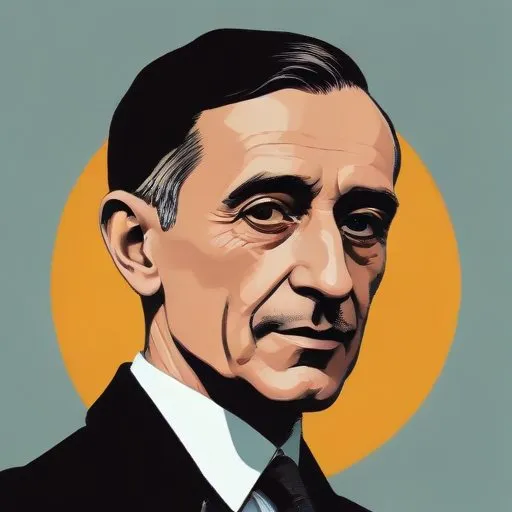
Invented the first powered vacuum cleaner, revolutionizing cleaning and hygiene practices. This innovation transformed the way people lived and worked, making a significant impact on public health.
Hubert Cecil Booth is renowned for inventing one of the first powered vacuum cleaners, revolutionizing the way people cleaned their homes and workplaces. Born on July 4, 1871, in Gloucester, England, Booth's innovative spirit and engineering prowess led him to create a machine that would change the cleaning industry forever.
Booth's early life was marked by a strong educational foundation. He attended Gloucester College and Gloucester County School under the guidance of headmaster Reverend H. Lloyd Brereton. In 1889, he entered the Central Technical College, City and Guild, London, where he completed a three-year course in civil engineering and mechanical engineering under Professor William Cawthorne Unwin FRS. Booth's stellar academic performance earned him the Diploma of Associateship ACGI, securing second place in the engineering department.
Booth's professional journey began in 1892, when he joined the drawing office of Messrs Maudslay Sons & Field, Lambeth, London, as a civil engineer. During this period, he designed bridges and large Ferris wheels for amusement parks in London, Blackpool, Paris, and Vienna. His work also extended to designing engines for Royal Navy battleships.
In 1901, Booth attended a demonstration of an American machine by its inventor at the Empire Music Hall in London. The machine, which blew dust off chairs, sparked an idea in Booth's mind. He envisioned a machine that could suck up dirt and dust, rather than simply blowing it away. This epiphany led Booth to create one of the first powered vacuum cleaners, marking a significant milestone in cleaning technology.
Booth's invention of the powered vacuum cleaner was not just a product of technical innovation, but also reflected his philosophical approach to problem-solving. He believed in the importance of identifying and addressing the root causes of problems, rather than just treating their symptoms. This mindset enabled him to create a machine that not only revolutionized cleaning but also improved indoor air quality and reduced dust-related health issues.
Booth's invention of the powered vacuum cleaner has had a profound impact on modern society. Today, vacuum cleaners are an essential household appliance, with millions of units sold worldwide every year. The cleaning industry has also undergone a significant transformation, with the development of more efficient and effective cleaning technologies.
In addition to his professional achievements, Booth's personal life was marked by significant milestones. He became Chairman and Managing Director of the British Vacuum Cleaner and Engineering Co., a testament to his entrepreneurial spirit and leadership abilities.
Hubert Cecil Booth's legacy extends far beyond his invention of the powered vacuum cleaner. He exemplified the power of innovation, perseverance, and creativity, leaving behind a lasting impact on the cleaning industry and modern society. As we continue to push the boundaries of technological advancement, Booth's story serves as a reminder of the importance of visionary thinking and problem-solving.
Born in 1806
A visionary engineer who revolutionized transportation with innovative designs, including the iconic Clifton Suspension Bridge, which transformed urban landscapes.
Born in 1781
Designed the Liverpool and Manchester Railway, a pioneering feat that revolutionized transportation and paved the way for modern rail networks.
Born in 1791
Pioneering scientist who discovered electromagnetic induction, formulated the laws of electrolysis, and invented the first electrical generator, revolutionizing our understanding of electricity and its applications.
Born in 1736
Improved steam engine efficiency, revolutionizing industry and transportation. Known for his innovative designs and patents that transformed the Industrial Revolution.
Born in 1791
A pioneer in computer science, credited with inventing the first mechanical computer, the Difference Engine, and conceptualizing the Analytical Engine, a precursor to modern computers.
Born in 1815
Pioneering mathematician and computer scientist who wrote the first algorithm intended to be processed by a machine, and is often considered the first computer programmer. Her work on Charles Babbage's Analytical Engine envisioned its potential to go beyond mere calculation and perform any task that could be expressed in a series of steps.
Born in 1771
Built steam-powered locomotives, revolutionizing land transportation, and pioneered the use of steam engines in mines.
Born in 1773
Designed and built the first successful glider, pioneering modern aeronautical engineering, and is often credited with inventing the first powered, heavier-than-air aircraft.
