


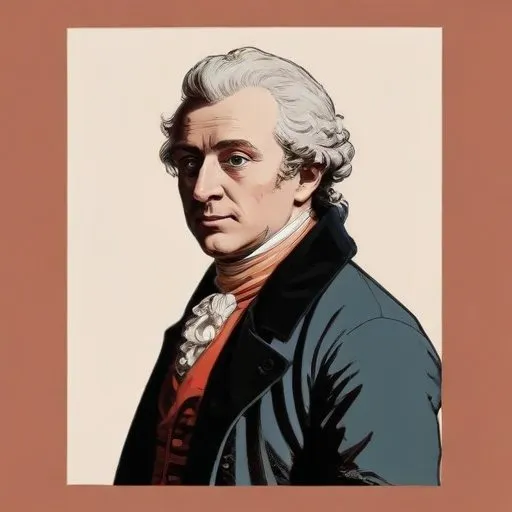
A French painter celebrated for his dreamy, fantastical landscapes and architectural scenes, often infused with a sense of romance and nostalgia.
Hubert Robert, a French painter, is renowned for his breathtaking landscape paintings and capricci, which transport viewers to a world of picturesque ruins in Italy and France. His work embodies the essence of Romanticism, a movement that celebrated the beauty of nature and the emotional response it evokes.
Born in Paris in 1733, Robert's fascination with art began at a young age. His father, Nicolas Robert, was in the service of François-Joseph de Choiseul, marquis de Stainville, a leading diplomat from Lorraine. Robert completed his studies with the Jesuits at the Collège de Navarre in 1751 and later entered the atelier of sculptor Michel-Ange Slodtz, where he honed his skills in design and perspective.
In 1754, Robert embarked on a journey to Rome, accompanying Étienne-François de Choiseul, son of his father's employer, who would later become French ambassador and Secretary of State for Foreign Affairs to Louis XV. During his eleven-year stay, Robert supported himself by creating works for visiting connoisseurs, including the abbé de Saint-Non, who introduced him to the ruins of Pompeii in Naples in 1760.
Robert's time in Rome was marked by his association with Giovanni Paolo Panini, whose influence is visible in his Vue imaginaire de la galerie du Louvre en ruine. He also befriended young artists in the circle of Piranesi, whose capricci of romantically overgrown ruins inspired Robert's unique style.
Today, Robert's work is celebrated for its emotional intensity, sense of nostalgia, and masterful use of light and shadow. His paintings continue to captivate audiences, inviting them to step into a world of beauty and decay.
Robert was elected a member of the Académie Royale de Peinture et de Sculpture in 1766 and later became its professor in 1779.
His work has been celebrated and exhibited globally, solidifying his position as one of the preeminent painters of the Romantic era.
Robert married in 1773 and had two children, but little is known about his personal life beyond his artistic pursuits.
He died on April 15, 1808, leaving behind a legacy that continues to inspire artists, architects, and art lovers alike.
Hubert Robert's paintings not only capture the essence of Romanticism but also reflect his own emotional response to the beauty and decay of the natural world. His work continues to influence contemporary artists, architects, and designers, ensuring his legacy endures for generations to come.
Born in 1732
A prolific Rococo painter and etcher, renowned for his delicate, whimsical, and often erotic works that capture the carefree spirit of 18th-century French aristocracy. His art often featured lush landscapes, gentle colors, and playful scenes of love and leisure.
Born in 1703
A prominent artist of the Rococo style, known for his delicate and ornate paintings, often depicting mythological and pastoral scenes, as well as designing sets for the Paris Opera.
Born in 1725
A French painter and educator renowned for his sentimental and moralizing genre scenes, often depicting young women in domestic settings, which captivated 18th-century audiences.
Born in 1684
A French painter who created delicate, dreamy, and intimate scenes of everyday life, often blending reality and fantasy, and is considered a pioneer of the Rococo style.
Born in 1748
A French painter and illustrator who revolutionized Neoclassicism with his realistic and emotive works, creating iconic pieces like "Oath of the Horatii" and "Napoleon Crossing the Alps".
Born in 1780
A renowned French Neoclassicist painter and illustrator, celebrated for his exquisite portraits and historical scenes that epitomize elegance and refinement. His work continues to inspire artists and art enthusiasts alike.
Born in 1798
A Romantic-era master of expressive brushstrokes and vivid color, creating iconic works that captured the drama and emotion of historical and literary scenes.
