


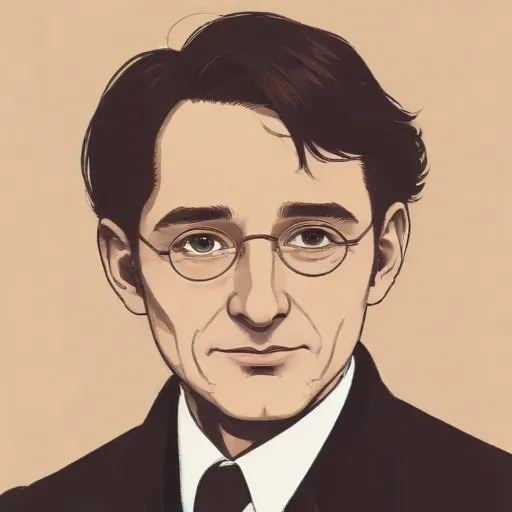
A founder of the Dada movement, he is known for his experimental poetry and performances that challenged traditional art forms. His work questioned the role of language and meaning in society.
Hugo Ball, a German author, poet, and artist, is renowned for founding the Dada movement in European art, a revolutionary anti-art movement that emerged in Zurich in 1916. He is also credited with pioneering sound poetry, a radical form of poetry that rejects traditional language and meaning.
Born on February 22, 1886, in Pirmasens, Germany, Ball grew up in a middle-class Catholic family. He pursued sociology and philosophy at the universities of Munich and Heidelberg from 1906 to 1907. His early interests in theater and acting led him to move to Berlin in 1910, where he collaborated with the renowned director Max Reinhardt.
The outbreak of World War I marked a turning point in Ball's life. He attempted to join the army as a volunteer but was rejected due to medical reasons. Witnessing the invasion of Belgium, Ball became disillusioned with the war, declaring, "The war is founded on a glaring mistake... men have been confused with machines." This experience led him to reject the nationalist fervor and seek a new path.
In 1916, Ball, along with his partner Emmy Hennings, a cabaret performer and poet, founded the Dada movement in Zurich, Switzerland. This radical movement rejected the traditional values and bourgeois culture that they believed had led to the devastating war. The Dada Manifesto, written by Ball, aimed to create a new language, free from the constraints of traditional meaning and purpose.
Ball was deeply influenced by anarchist philosophy, particularly the works of Mikhail Bakunin. While he rejected anarchism's militant aspects, he saw it as a means to achieve sociopolitical enlightenment. Ball's philosophy centered around the idea of creating a new, liberated humanity, free from the shackles of traditional norms and values.
Ball's innovative approach to poetry led to the development of sound poetry, a genre that emphasizes the sonic quality of words over their meaning. His phonetic poetry, written in invented languages, aimed to break free from the constraints of traditional language and create a new, universal form of expression.
The Dada movement, founded by Ball, paved the way for a wide range of avant-garde movements, including Surrealism, Constructivism, and Absurdism. His sound poetry influenced generations of poets, musicians, and artists, from Kurt Schwitters to John Cage. Ball's radical ideas and artistic innovations continue to inspire artists, writers, and thinkers to this day.
Hugo Ball married Emmy Hennings in 1920, and the couple settled in Switzerland. Ball passed away on September 14, 1927, at the age of 41. His legacy extends far beyond his own artistic contributions, as he helped shape the course of modern art, literature, and philosophy.
Hugo Ball's life and work serve as a testament to the power of artistic innovation and the importance of challenging traditional norms and values. His legacy continues to inspire and provoke, ensuring his place as one of the most influential artists of the 20th century.
Born in 1877
A renowned poet, novelist, and painter, celebrated for his thought-provoking and introspective works that explore the human condition, spirituality, and the search for meaning. His writings often blended elements of psychology, philosophy, and mysticism.
Born in 1882
A pioneering modernist writer, known for experimental novels and short stories that explore the human experience, particularly in Dublin, Ireland. His works are celebrated for their complex, lyrical prose and innovative narrative structures.
Born in 1885
A pioneering modernist poet and critic who transformed 20th-century literature with innovative styles and provocative ideas, shaping the course of modern poetry.
Born in 1888
A renowned poet, playwright, and critic who reshaped modern poetry with works like "The Waste Land" and "Old Possum's Book of Practical Cats", influencing literature and art with their unique style.
Born in 1865
A renowned Irish wordsmith and dramatist, celebrated for his mystical and nationalistic verse that explores the human condition, as well as his contributions to the Irish Literary Revival.
Born in 1875
A visionary poet and novelist who explored the human condition through lyrical and philosophical works, delving into the mysteries of existence, love, and the self.
Born in 1883
A writer of surreal, psychologically complex fiction that explores the human condition, often featuring isolated protagonists in absurd, nightmarish scenarios.
Born in 1886
A leading figure of Expressionism, this poet and essayist explored the human condition through provocative and innovative works, blending philosophy and art.
