


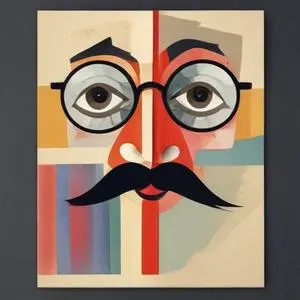
A pioneer of Dadaism, creating avant-garde collages and assemblages that blurred the lines between art and everyday life. His innovative approach to art paved the way for future generations of artists .
Kurt Schwitters was a German artist renowned for his revolutionary Merz Pictures, a fusion of Dadaism, Constructivism, and Surrealism that redefined the boundaries of modern art. His innovative use of collage, poetry, sound, painting, sculpture, and installation art made him a pioneer in the avant-garde movement of the early 20th century.
Born on June 20, 1887, in Hanover, Germany, Schwitters was the only child of Eduard and Henriette Schwitters. His father's ladies' clothing shop provided a comfortable income, allowing the family to live off the profits and rent out properties in Hanover. This financial security enabled Schwitters to pursue his artistic interests without financial constraints.
In 1901, Schwitters suffered his first epileptic seizure, a condition that would later exempt him from military service in World War I. He went on to study art at the Dresden Academy alongside Otto Dix and George Grosz, although he seemed unaware of their work or the contemporary Dresden artists Die Brücke.
In 1911, Schwitters participated in his first exhibition in Hanover, showcasing his postimpressionist works. As World War I progressed, his art took on a darker, more expressionist tone. During the war, he worked as a draftsman in a factory outside Hanover, an experience that influenced his later work.
In 1919, Schwitters coined the term "Merz" to describe his unique approach to art. Merz, derived from the German word "Kommerz," signified a fusion of art and commerce, as well as a rejection of traditional aesthetics. Schwitters' Merz Pictures, characterized by fragmented forms and bold colors, challenged the dominant artistic movements of the time.
In 1937, Schwitters fled Germany to escape the Nazi regime, which deemed his art "degenerate." He settled in Norway, where he continued to work on his Merz Pictures and develop his theory of "Merz Bau," a concept that blurred the lines between art, architecture, and environment.
After Norway was invaded by Germany in 1940, Schwitters moved to England, where he remained until his death on January 8, 1948. During his years in exile, Schwitters continued to innovate, experimenting with new materials and techniques that expanded the scope of modern art.
Kurt Schwitters' Merz Pictures and theories have had a profound impact on modern and contemporary art. His pioneering work in collage, assemblage, and installation art paved the way for artists like Robert Rauschenberg, Jasper Johns, and Joseph Cornell.
Schwitters' emphasis on the importance of art in everyday life, as well as his rejection of traditional aesthetics, has influenced generations of artists, designers, and architects. His legacy extends beyond the art world, inspiring creative thinkers across disciplines to challenge convention and push the boundaries of innovation.
Kurt Schwitters was awarded the Carnegie Prize in 1947 for his contribution to modern art. His work is held in high esteem by museums and institutions worldwide, including the Tate Modern, the Museum of Modern Art, and the Centre Pompidou.
In 1915, Schwitters married Helma Fischer, with whom he had one son, Ernst. The couple divorced in 1937, and Schwitters later married Edith Thomas in 1944.
Schwitters' Merzbau, a sprawling, interactive installation in his Hanover studio, was destroyed in a bombing raid in 1943. Although Schwitters recreated parts of the installation in Norway and England, the original Merzbau remains an important but lost work in the history of modern art.
Kurt Schwitters' life and art continue to inspire creative minds across the globe, leaving an indelible mark on the development of modern and contemporary art.
Born in 1889
A pioneering artist of the Dada movement, known for creating innovative photomontages that challenged societal norms and blurred the lines between art and politics.
Born in 1871
A German-American painter and illustrator who blended cubism and futurism to create vibrant, abstracted cityscapes and seascapes, influencing the development of modern art.
Born in 1885
A pioneer of Orphism, a style of abstract art that emphasizes geometric shapes and vibrant colors, creating dynamic and expressive works that explore the emotional potential of color. 42
Born in 1883
A Dutch artist who founded the De Stijl art movement, characterized by geometric shapes and primary colors, and is known for his abstract paintings and architectural designs.
Born in 1890
A pioneer of avant-garde art, he merged photography and architecture to create innovative, abstract compositions that redefined visual storytelling. His works continue to inspire artists and designers today.
Born in 1878
A Ukrainian painter and theorist who founded the Suprematist movement, creating geometric abstract works that explored the emotional and spiritual properties of color. They're most known for their iconic "Black Square" painting.
Born in 1881
A pioneering artist who transformed modern art with pioneering Cubist works, creating a new visual language that continues to inspire and influence art, design, and culture.
