


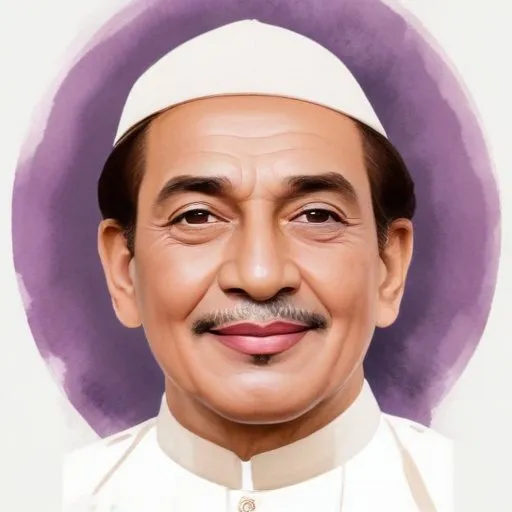
A Bangladeshi general and politician who served as the 10th President of Bangladesh, known for his military-backed rule and implementation of various economic and infrastructure development projects. He played a significant role in shaping Bangladesh's politics and economy.
Hussain Muhammad Ershad was a household name in Bangladesh, known for his long-standing presidency from 1983 to 1990 and his significant contributions to the country's infrastructure, economy, and politics. As a military officer and politician, Ershad played a pivotal role in shaping Bangladesh's destiny, leaving an indelible mark on the nation's history.
Ershad was born on February 1, 1930, in Dinhata, Cooch Behar district, India, to Mokbul Hossain and Mazida Khatun. He hailed from a Bengali-speaking Nashya Shaikh family. His father, Mokbul, was a lawyer who served as a minister in the then-British India government.
In 1982, Ershad seized power as the head of the army, imposing martial law and suspending the Constitution. He declared himself President in 1983, following a bloodless coup against President Abdus Sattar. Despite controversy surrounding his election in 1986, Ershad's regime continued until 1990, when he was forced to resign due to a popular pro-democracy mass uprising led by Khaleda Zia and Sheikh Hasina.
Ershad's presidency saw significant reforms and developments in various sectors. Some of his notable contributions include:
Ershad founded the Jatiya Party in 1986 and became a Member of Parliament for the party in the constituency of Rangpur-3 in 1991. He was re-elected in all subsequent general elections, making him the longest-serving male head of government in Bangladeshi history.
Ershad's regime was marked by controversy, with critics accusing him of authoritarianism and human rights abuses. However, his contributions to Bangladesh's infrastructure, economy, and politics cannot be ignored. He played a significant role in shaping the nation's destiny, leaving behind a legacy that continues to influence Bangladeshi politics today.
"I want to see a Bangladesh where everyone has a place to live, a job to do, and an opportunity to prosper." - Hussain Muhammad Ershad
Ershad's presidency came at a critical juncture in Bangladesh's history, following the country's liberation in 1971. His regime, though marked by controversy, played a significant role in shaping Bangladesh's future, making him a complex and multifaceted figure in the country's history.
Hussain Muhammad Ershad's life and legacy continue to inspire and influence Bangladeshi politics, serving as a testament to the power of leadership and vision in shaping a nation's destiny.
Born in 1920
Led the Bengali nationalist movement, guiding Bangladesh to independence from Pakistan, and is revered as the "Father of the Nation" for his role in shaping the country's identity.
90 Years Old
Led the Bangladesh Liberation War, establishing Bangladesh as an independent nation, and implemented economic and political reforms. He's a national hero, revered for his role in shaping the country's identity.
81 Years Old
The first female Prime Minister of Bangladesh, serving from 1991 to 1996, known for her efforts to promote democracy and economic development in the country.
78 Years Old
The 10th Prime Minister of Bangladesh, a prominent leader who has been instrumental in shaping the country's politics and economy, particularly in the areas of women's empowerment and poverty reduction.
