


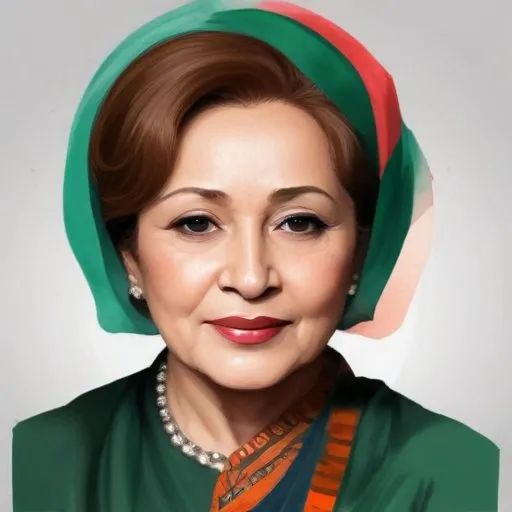
The first female Prime Minister of Bangladesh, serving from 1991 to 1996, known for her efforts to promote democracy and economic development in the country.
Khaleda Zia, the first female prime minister of Bangladesh, is a name synonymous with power, resilience, and controversy. Her two stints as prime minister, from 1991 to 1996 and again from 2001 to 2006, were marked by periods of political upheaval, economic instability, and corruption allegations.
Born in 1945 as Khaleda Khanam Putul, she became involved in politics through her marriage to Ziaur Rahman, a Bangladeshi military officer and politician who would later become the president of Bangladesh. After her husband's assassination in 1981, Khaleda took the reins of the Bangladesh Nationalist Party (BNP), founded by her husband in 1978, and transformed it into a powerful political force.
Khaleda played a crucial role in the movement for democracy in Bangladesh, leading protests and rallies against the military rule of General Hussain Muhammad Ershad. Her unwavering stance against military dictatorship ultimately led to Ershad's downfall in 1990, paving the way for democratic elections in 1991, which the BNP won, propelling Khaleda to the prime minister's seat.
Khaleda's political career was marked by a bitter rivalry with Awami League leader Sheikh Hasina, who would also go on to become prime minister. The two women have been the only females to hold the office of prime minister in Bangladesh, and their rivalry has been a defining feature of Bangladeshi politics since the 1980s. The country has witnessed periods of political violence, boycotts, and electoral manipulation, with both leaders trading accusations of corruption and misgovernance.
In 2018, Khaleda was sentenced to a total of 17 years in prison on corruption charges related to the Zia Orphanage Trust and Zia Charitable Trust cases. The verdict was widely seen as politically motivated, and her party has consistently maintained that the charges were fabricated.
Despite her turbulent reign, Khaleda has left an indelible mark on Bangladeshi politics. She has been a trailblazer for women in politics, inspiring a generation of female leaders in the country. However, her legacy is also marred by allegations of corruption, nepotism, and misgovernance, which have contributed to Bangladesh's poor ranking in the Corruption Perceptions Index during her tenure.
"I have always believed that women can bring about change in society, and I will continue to fight for their rights and empowerment."
Khaleda's story is a testament to the complexities of power, politics, and the struggle for democracy in Bangladesh. While her legacy is shrouded in controversy, her impact on the country's political landscape is undeniable.
78 Years Old
The 10th Prime Minister of Bangladesh, a prominent leader who has been instrumental in shaping the country's politics and economy, particularly in the areas of women's empowerment and poverty reduction.
96 Years Old
A Bangladeshi general and politician who served as the 10th President of Bangladesh, known for his military-backed rule and implementation of various economic and infrastructure development projects. He played a significant role in shaping Bangladesh's politics and economy.
Born in 1925
The first Prime Minister of Bangladesh, leading the country to independence from Pakistan in 1971, and playing a key role in shaping the nation's early years.
90 Years Old
Led the Bangladesh Liberation War, establishing Bangladesh as an independent nation, and implemented economic and political reforms. He's a national hero, revered for his role in shaping the country's identity.
99 Years Old
The 10th President of Bangladesh, a prominent banker and politician, served from 1991 to 1996 and played a key role in the country's transition to democracy. He's remembered for his efforts to strengthen the economy and promote national unity.
