


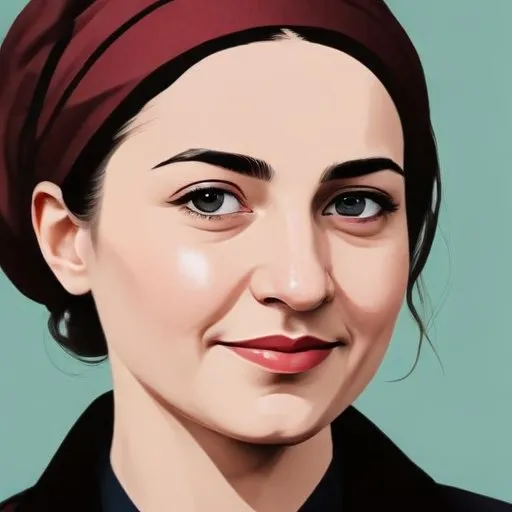
A Belarusian Jewish anarchist who fought against the Russian Empire and later became a prominent figure in the French anarchist movement, known for her activism and writings on anarchism and feminism.
Ida Mett, a Belarusian Jewish anarchosyndicalist, physician, and writer, left an indelible mark on the anarchist movement with her tireless activism, eloquent writings, and unwavering commitment to creating a more just society.
Born Ida Markovna Gilman on July 7, 1901, in Smarhon, Belarus, Mett was exposed to radical ideas from a young age. Her family, cloth merchants, instilled in her a sense of social responsibility that would guide her actions throughout her life. As a young woman, she moved to Moscow to study medicine, where she became an active participant in the Russian anarchist movement.
In 1924, Mett was arrested on charges of anti-Soviet agitation and deported from Russia. She fled first to Poland and then to Paris, where she adopted the pen name Ida Mett and co-edited the Russian anarchist magazine Delo Truda. This period marked the beginning of her collaboration with Ukrainian anarchists Peter Arshinov and Nestor Makhno, with whom she penned the Organisational Platform of the General Union of Anarchists, the founding document of the anarchist tendency known as platformism.
Through Delo Truda, Mett reported on the meetings in which The Platform was discussed, noting the objections of French and Chinese anarchists. She defended the provisions in The Platform for the ideological direction of the masses, arguing it was necessary for anarchists to make their ideas predominate within the workers' movement and distinguishing the tactic from party political aspirations to take state power.
Mett's work on Delo Truda and her involvement in the platformist movement earned her a reputation as a visionary and a leader. Her network of influence extended across Europe, with connections to anarchist groups in Belgium, Spain, and France. Her writing and activism inspired a new generation of anarchists, shaping the course of the movement for decades to come.
After the outbreak of World War II, Mett was forced to cease her anarchist activities due to repression by the fascist Vichy regime. She spent the final decades of her life working as a nurse and publishing history books. Despite the challenges she faced, Mett remained committed to her anarchist ideals, continuing to write and inspire until her death in 1973.
Ida Mett's life and work serve as a testament to the power of dedication and conviction. Her contributions to the anarchist movement continue to inspire and educate new generations of activists, thinkers, and dreamers. As a pioneer of platformism, Mett's legacy is a reminder that even in the darkest of times, the human spirit can persevere and create positive change.
Born in 1869
A Lithuanian-Canadian philosopher and activist who advocated for anarchism, free speech, and women's rights, playing a pivotal role in shaping modern feminist and political thought.
Born in 1870
A Lithuanian-American anarchist and writer who advocated for labor rights and prison reform through his writings and activism, including a 14-year prison sentence for attempting to assassinate a businessman.
Born in 1882
A Russian anarchist intellectual who wrote extensively on the Russian Revolution and its aftermath, criticizing the Bolsheviks' authoritarianism and advocating for a decentralized, stateless society.
Born in 1842
A Russian polymath who contributed significantly to various fields, including zoology, economics, and geography, and is renowned for his anarchist philosophy and advocacy for mutual aid.
Born in 1814
A Russian philosopher and theorist who advocated for anarchism and the abolition of the state, and is known for his influence on the development of anarchist thought. His ideas emphasized individual freedom and the rejection of authority.
Born in 1809
A 19th-century French economist and politician who advocated for anarchism, socialism, and mutualism, and is known for coining the phrase "Property is Theft."
Born in 1888
A Ukrainian anarchist revolutionary who led an insurrection against the Bolsheviks during the Russian Civil War, known for his charismatic leadership and innovative military tactics.
Born in 1873
A prominent anarchist writer and historian, known for his influential works on anarcho-syndicalism and his role in the development of modern anarchist thought.
