


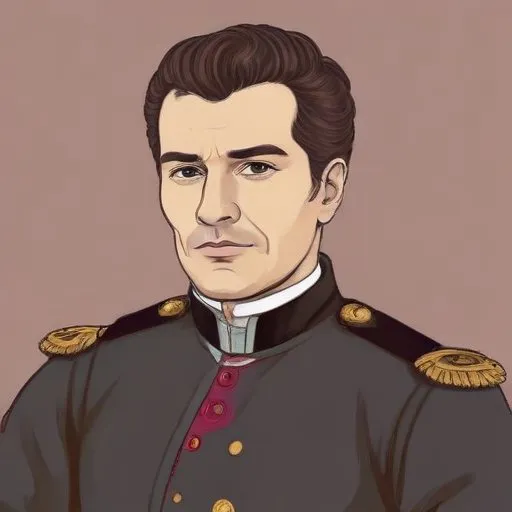
Austrian nobleman and government official who served as the Governor of Tyrol and played a key role in the suppression of the Tyrolean Rebellion against Napoleon. He's known for his administrative and military skills.
Ignaz Anton von Indermauer is best known for his unwavering dedication to his duties as the Landvogt and Kreishauptmann of Vorarlberg, a region in modern-day Austria, from 1791 until his untimely death in 1796. During his tenure, he oversaw the administration of legal and financial affairs, earning both admiration and scorn for his unrelenting implementation of the Josephine reforms.
Born on July 31, 1759, into the esteemed Tyrolese noble family of In der Maur zu Strelburg und Freifeld, Ignaz Anton von Indermauer was educated in Innsbruck and went on to study law. His strong academic foundation laid the groundwork for his future success in the state service.
In 1789, Indermauer arrived in Vorarlberg and assumed leadership of the district office. Two years later, he was appointed the Landvogt and Kreishauptmann, a position that entrusted him with the responsibility of governing the region and representing the Habsburg crown. As the highest-ranking official in Vorarlberg, Indermauer worked tirelessly to implement the reforms instituted by Holy Roman Emperor Joseph II, despite fierce opposition from conservative factions.
The reforms, aimed at limiting the authority of the Catholic Church within the Holy Roman Empire, sparked widespread outrage across Austria. Indermauer's steadfast commitment to enforcing these reforms earned him the ire of conservative groups, who saw him as an agent of radical change. His unyielding stance on this matter led to investigations against those who opposed the reforms, further solidifying his reputation as a man of principle.
As the French Revolution began to spread across Europe, Indermauer took decisive action to protect Vorarlberg from the instability. He banned immigration from areas affected by the revolution and prohibited the export of goods, moves that were deeply unpopular among local merchants and seasonal workers. Despite the backlash, Indermauer remained resolute in his efforts to safeguard the region.
On August 8, 1796, French troops approached the Austrian border, and Indermauer was forced to flee Vorarlberg, leaving behind his life's work. He escaped to Tyrol, where he later died on August 10, 1796. Despite his untimely departure, Indermauer's unwavering commitment to duty and principle has etched his name in the annals of Vorarlberg's history, earning him a reputation as a courageous and dedicated administrator.
Ignaz Anton von Indermauer's life and career serve as a testament to the complexities of governing during times of turmoil. His dedication to the Josephine reforms and his steadfast commitment to duty, even in the face of adversity, have secured his place in the history of Vorarlberg. As a champion of reform and a symbol of Austrian resilience, Indermauer's legacy continues to inspire and educate generations to come.
Born in 1863
Heir to the Austro-Hungarian throne whose assassination in Sarajevo sparked World War I. A symbol of imperial power and a catalyst for global conflict.
Born in 1868
The last emperor of Russia, ruling from 1894 to 1917, known for his poor leadership and decisions that led to the downfall of the Romanov dynasty and the rise of communism.
Born in 1865
A German general and politician who played a crucial role in World War I, masterminding the 1918 Spring Offensive and later promoting Nazi ideology.
Born in 1847
A German field marshal and politician who served as the 2nd President of Germany during the Weimar Republic, playing a crucial role in the rise of the Nazi Party. He's infamous for appointing Adolf Hitler as Chancellor of Germany in 1933.
Born in 1857
Austro-Hungarian general who played a key role in the Austro-Prussian War and later became a prominent military strategist, known for his innovative tactics and modernization of the Austro-Hungarian army.
Born in 1830
The longest-reigning ruler of Austria-Hungary, presiding over a vast empire that spanned across Central Europe, and remembered for his role in shaping European history through diplomacy and war.
