


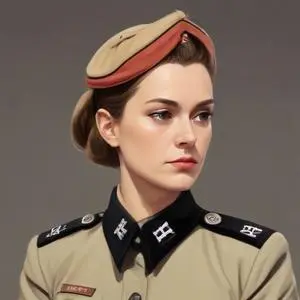
Notorious Nazi concentration camp commander's wife, known for her brutal and sadistic behavior, including making lampshades from human skin.
Ilse Koch, also known as the "Witch of Buchenwald", was a German war criminal who committed unspeakable atrocities during World War II. She gained notoriety for her alleged role in selecting prisoners with tattoos to be killed, and then using their skin to make lampshades and other items, earning her a reputation as one of the most infamous Nazi figures of the war.
Koch was born Margarete Ilse Köhler on September 22, 1906, in Dresden, Germany, to a former military commander. Her early life is shrouded in mystery, but it is known that she married Karl Otto Koch, a Nazi officer, in 1936.
Ilse Koch's husband, Karl Otto Koch, became the commandant of the Buchenwald concentration camp, where Ilse would often visit and participate in the daily operations of the camp. It was during this time that she gained a reputation for her cruelty and lasciviousness towards prisoners, earning her the nickname "Die Hexe von Buchenwald" (The Witch of Buchenwald) among the inmates.
In 1947, Ilse Koch was put on trial by an American military commission court at Dachau, where she faced charges of war crimes and crimes against humanity. The trial received widespread media attention, with many survivors testifying against her and detailing her alleged atrocities. However, despite the sensational claims, the court found that many of the allegations against her were unfounded and lacked concrete evidence.
Notwithstanding, the public perception of Ilse Koch as a sadistic and cruel figure persisted, with many nicknames such as "The Beast of Buchenwald", "The Queen of Buchenwald", "The Red Witch of Buchenwald", "Butcher Widow", and "The Bitch of Buchenwald" sticking.
Ilse Koch's legacy is one of horror and revulsion, a symbol of the darkest aspects of human nature. Her story serves as a reminder of the atrocities committed during World War II and the importance of holding individuals accountable for their actions. While the details of her life and crimes may be disputed, her name has become synonymous with evil, and her infamy will endure for generations to come.
Born in 1900
Leading the SS and Gestapo, he oversaw the Nazi regime's brutal security apparatus and implemented the "Final Solution," orchestrating the genocide of six million Jews during World War II.
Born in 1892
A ruthless and efficient administrator who oversaw the creation and operation of Nazi concentration camps during World War II, responsible for the deaths of millions of people.
Born in 1893
A high-ranking Nazi official, he was a decorated World War I fighter pilot and later became a prominent politician, serving as Minister President of Prussia. He's infamous for his role in the Nazi regime and war crimes trials.
Born in 1893
A German diplomat who served as the Nazi regime's Foreign Minister, orchestrating key alliances and treaties that led to World War II. He was a close associate of Adolf Hitler and played a crucial role in shaping Nazi foreign policy.
Born in 1903
Austrian-German lawyer and general who served as the highest-ranking leader of the Nazi police forces, responsible for overseeing the Gestapo, SS, and concentration camps during World War II. He was a key figure in the Holocaust and other atrocities committed by the Nazi regime.
Born in 1904
A high-ranking Nazi official and chief architect of the Holocaust, responsible for implementing the "Final Solution" that led to the murder of six million Jews and millions of others during World War II.
