


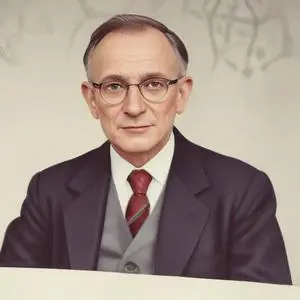
A renowned sociologist and historian who developed the concept of world-systems theory, analyzing global economic and social structures, and their impact on modern societies.
Immanuel Wallerstein, a renowned American sociologist and economic historian, is best known for developing the world-systems approach, a groundbreaking framework that revolutionized the field of sociology. His pioneering work has left an indelible mark on our understanding of global capitalism, economies, and societies.
Born on September 28, 1930, in New York to Polish Jewish parents, Sara and Menachem Lazar Wallerstein, Immanuel grew up in a politically conscious family that instilled in him a passion for world affairs. He went on to receive all three of his degrees from Columbia University, including a PhD in 1959, where he was supervised by Hans L. Zetterberg and Robert Staughton Lynd.
Wallerstein's academic career spanned multiple universities around the world, including Oxford University, Université libre de Bruxelles, and Universidad Nacional Autónoma de México. He served as the 13th president of the International Sociological Association from 1994 to 1998 and was a Senior Research Scholar at Yale University from 2000 until his death in 2019.
His magnum opus, The Modern World-System, a three-volume work published between 1974 and 1989, laid the foundation for the world-systems approach. This influential theory posits that the global economy is a single, interconnected system that has evolved over time, shaped by the interactions between core, periphery, and semi-periphery countries.
Wallerstein's work has had a profound impact on our understanding of global capitalism, globalization, and economic inequality. His ideas have influenced scholars across disciplines, from sociology and economics to history and politics. His work has also resonated with activists and policymakers seeking to address issues of poverty, inequality, and social justice.
Wallerstein's personal life was marked by significant milestones, including his marriage to Beatrice Friedman in 1961 and his service in the U.S. Army from 1951 to 1953. He also published bimonthly syndicated commentaries on world affairs through Agence Global from 1998 to 2019.
Immanuel Wallerstein's contributions to sociology and economic history have left an enduring legacy. His work continues to inspire new generations of scholars and thinkers, and his ideas remain relevant in today's increasingly interconnected world. Through his tireless efforts to understand and explain the complexities of global capitalism, Wallerstein has left an indelible mark on our understanding of the world and our place within it.
These seminal works, along with his numerous articles and commentaries, have cemented Wallerstein's position as a leading thinker in his field, and his ideas will continue to shape our understanding of the world for generations to come.
Born in 1902
A pioneer of the Annales School, he revolutionized historical studies by focusing on long-term social and economic structures rather than individual events, and is renowned for his three-volume masterpiece, "Civilization and Capitalism".
Born in 1818
A 19th-century philosopher who developed the theory of communism, arguing that capitalism would eventually be replaced by a socialist society. He's known for his critique of capitalism and the concept of class struggle.
Born in 1864
Developed the concept of "social action" and is known for his theories on bureaucracy, capitalism, and the role of religion in shaping society.
Born in 1858
A founder of modern sociology, known for establishing the field and exploring the relationships between individuals and society, particularly in his work "Suicide".
96 Years Old
A French sociologist, anthropologist, and philosopher who developed the concept of "cultural capital" and critiqued social inequality, highlighting how power and privilege are maintained through cultural and symbolic means.
88 Years Old
A prominent sociologist who developed the theory of structuration, which explores the relationship between individual agency and social structure, and is known for his work on modernity and globalization.
82 Years Old
A renowned sociologist who coined the term "risk society" to describe modern societies' obsession with managing and mitigating risks, and is also known for his work on globalization and individualization.
90 Years Old
A renowned geographer and academic who has made significant contributions to the field of Marxist geography, critically analyzing the effects of capitalism on urban spaces and social inequality.
