


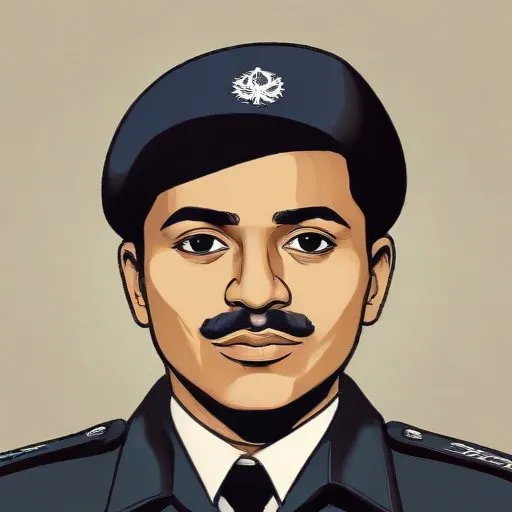
India's first fighter aircraft pilot, who earned distinction in World War I, credited with 10 aerial victories, and posthumously awarded the Distinguished Service Cross.
Indra Lal Roy, a Bengali aviator, etched his name in history as the sole Indian World War I flying ace, claiming ten aerial victories in just over 170 hours of flying time. Born on December 2, 1898, in Calcutta, India, Roy's bravery and skill in the skies earned him a revered place in Indian military history.
Roy was the second son of Piera Lal Roy, a barrister and Director of Public Prosecutions, and Lolita Roy. He hailed from a distinguished Bengali Brahmin family, originally from the Barisal district in present-day Bangladesh. The Roy family estate, Lakhutia, was founded by Roop Chandra Roy in the late 17th century and was a prominent Zamindar family of East Bengal.
When World War I broke out, Roy was attending St. Paul's School, Hammersmith in London, England. Initially rejected by the Royal Flying Corps due to poor eyesight, Roy paid for a second opinion from a leading eye specialist, and the decision was overturned. On April 4, 1917, he joined the RFC, and was commissioned as a second lieutenant on July 5.
After completing his training, Roy saw action on the Western Front, where he quickly made a name for himself as a skilled and fearless pilot. His aerial victories included five aircraft destroyed, one shared, and five down out of control, one shared.
Roy's aerial victories were a significant achievement, considering he achieved them in a relatively short period of time. His bravery and skill in combat earned him a reputation as one of the most feared pilots in the skies.
Tragically, Roy's life was cut short when he was killed in action on July 22, 1918, at just 19 years old. His aircraft crashed during a dogfight with enemy planes, and he was buried in the Estevenes Communal Cemetery in France.
Indra Lal Roy's legacy extends far beyond his impressive aerial record. He paved the way for Indian airmen and inspired generations of pilots to follow in his footsteps. His bravery and sacrifice will never be forgotten, and his name remains synonymous with Indian military valor.
Born in 1917
The first female Prime Minister of India, serving from 1966 to 1977 and again from 1980 until her assassination in 1984, known for her strong leadership and economic reforms.
Born in 1884
India's first president, a key figure in the country's struggle for independence, who played a crucial role in shaping the nation's early years. He's revered for his leadership and commitment to democracy.
Born in 1889
India's first Prime Minister, a key figure in the country's struggle for independence from British rule, and a champion of democracy and secularism. He played a crucial role in shaping modern India's government and economy.
Born in 1897
Indian freedom fighter and politician who led the Indian National Army against British rule and was a key figure in the country's struggle for independence. He is also known for his mysterious disappearance in 1945.
Born in 1914
India's first field marshal, a decorated war hero who led the country to victory in the 1971 Bangladesh Liberation War, earning him legendary status in Indian military history.
Born in 1909
Pioneering physicist who made groundbreaking contributions to the development of quantum mechanics and the discovery of subatomic particles, earning him the title "Father of Indian Nuclear Physics".
