


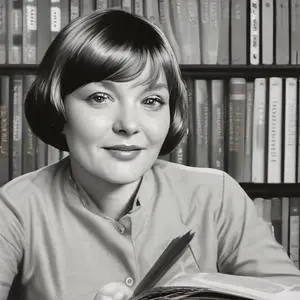
A renowned author and philosopher who explored the human condition through novels and philosophical works, delving into themes of morality, love, and existence.
Iris Murdoch, a towering figure in 20th-century literature, is renowned for her novels that probed the intricacies of human morality, the power of the unconscious, and the eternal struggle between good and evil. Her works, often lyrical and poignant, delve into the complexities of human relationships, sexuality, and ethics, earning her a reputation as a philosopher-novelist of unmatched depth.
Born on July 15, 1919, in Phibsborough, Dublin, Ireland, Murdoch was the only child of Wills John Hughes Murdoch and Irene Alice Richardson. Her father, a civil servant, and her mother, a trained singer, instilled in her a love for literature and philosophy from an early age. The family moved to London when she was just a few weeks old, and Murdoch went on to study classics, ancient history, and philosophy at Somerville College, Oxford.
Murdoch's writing career spanned over four decades, during which she penned 26 novels, numerous plays, and philosophical treatises. Her first novel, Under the Net (1954), was chosen as one of Modern Library's 100 best English-language novels of the 20th century in 1998. This was followed by a string of critically acclaimed works, including The Bell (1958), A Severed Head (1961), and The Black Prince (1973).
Her magnum opus, The Sea, The Sea (1978), won the Booker Prize, solidifying her position as a literary giant. Other notable works include The Red and the Green (1965), The Nice and the Good (1968), and The Philosophers Pupil (1983).
Murdoch's philosophical writings, particularly The Sovereignty of Good (1970), explored the nature of morality, the importance of individual moral agency, and the role of art in shaping our understanding of the world. Her philosophy focuses on the concept of "goodness" as an intrinsic, yet elusive, aspect of human existence.
In recognition of her contributions to literature, Murdoch was appointed a Dame Commander of the Order of the British Empire (DBE) in 1987. She was also awarded numerous honorary degrees from prestigious institutions, including Oxford, Cambridge, and Harvard.
Murdoch married John Bayley, a literary critic and author, in 1956, and the couple enjoyed a long and fulfilling marriage that lasted until her death in 1999. Bayley's memoir, Elegy for Iris (1999), is a poignant tribute to their relationship and Murdoch's struggles with Alzheimer's disease.
Iris Murdoch's work continues to influence contemporary literature, philosophy, and popular culture. Her novels have been translated into numerous languages, and her philosophical ideas have inspired generations of thinkers and writers. In 2008, The Times ranked her twelfth on a list of the 50 greatest British writers since 1945.
As a testament to her enduring legacy, Murdoch's work remains a rich source of inspiration for anyone grappling with the complexities of human nature and the pursuit of moral excellence.
Born in 1905
Existentialist philosopher and playwright who argued that humans have complete freedom to choose their actions and create their own meaning in life, influencing modern thought on morality and individual responsibility.
Born in 1908
A pioneering feminist philosopher who wrote extensively on ethics, politics, and gender, famously arguing that "one is not born, but rather becomes, a woman."
Born in 1889
A German philosopher and academic who explored the meaning of existence, time, and human existence, influencing 20th-century philosophy with his concept of "Being-in-the-world".
44 Years Old
Mozambican professional footballer who played as a defender and won several titles with his club, including the CAF Champions League. He's known for his skills and achievements in African football.
95 Years Old
A pioneer of French New Wave cinema, known for experimental and provocative films that challenged traditional narrative structures and explored themes of politics, philosophy, and social commentary.
Born in 1856
Pioneering psychoanalyst who developed theories on the subconscious mind, childhood experiences, and the structure of personality, revolutionizing our understanding of human behavior and psychology.
Born in 1882
A pioneering author of modernist literature, known for experimental novels and essays that explored the human experience, blurring the lines between reality and fiction.
