


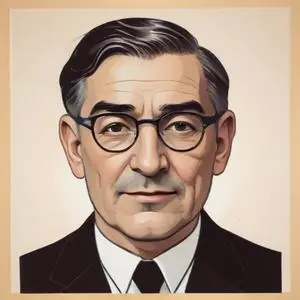
Developed groundbreaking theories on surface chemistry and discovered neon lighting, revolutionizing industries like advertising and entertainment.
Irving Langmuir was a renowned American chemist, physicist, and engineer who left an indelible mark on the scientific community with his groundbreaking work on surface chemistry, earning him the Nobel Prize in Chemistry in 1932. His most celebrated publication, "The Arrangement of Electrons in Atoms and Molecules" (1919), revolutionized the understanding of atomic structure, making him a household name in the scientific fraternity.
Born on January 31, 1881, in Brooklyn, New York, Langmuir was the third of four children to Charles Langmuir and Sadie, ne Comings. His childhood was marked by a curiosity-driven approach, encouraged by his parents, which led him to meticulously observe nature and maintain a detailed record of his observations. His poor eyesight, corrected at the age of eleven, only heightened his fascination with the intricacies of nature.
Langmuir's older brother, Arthur Langmuir, a research chemist, played a significant role in nurturing his curiosity. Arthur helped Irving set up his first chemistry lab in his bedroom and patiently answered his numerous questions, fostering a strong foundation for his future endeavors.
Langmuir's most significant contribution was his concentric theory of atomic structure, which built upon Gilbert N. Lewis's cubical atom theory and Walther Kossel's chemical bonding theory. Although he was embroiled in a priority dispute with Lewis over this work, Langmuir's exceptional presentation skills were instrumental in popularizing the theory. His work at General Electric (1909-1950) led to advancements in various fields of physics and chemistry, including the invention of the gas-filled incandescent lamp and the hydrogen welding technique.
The Langmuir Laboratory for Atmospheric Research near Socorro, New Mexico, was named in his honor, as was the American Chemical Society journal for surface science, Langmuir. His pioneering work continues to inspire generations of scientists, and his legacy serves as a testament to the power of human curiosity and innovation.
Langmuir's passion for mountaineering and the great outdoors often found him escaping to the mountains to clear his mind and rejuvenate his spirit. This unique blend of scientific rigor and adventurous spirit made him a truly remarkable individual.
Born in 1867
A pioneering scientist who pioneered radioactivity research, discovering elements polonium and radium, and paving the way for breakthroughs in medicine and energy.
Born in 1901
Pioneering chemist and peace activist who won two unshared Nobel Prizes, one for chemistry and one for peace, for his groundbreaking work on the nature of the chemical bond and his tireless efforts to promote nuclear disarmament.
Born in 1892
A Nobel Prize-winning physicist who discovered the Compton effect, a phenomenon where light scatters off free electrons, leading to a deeper understanding of light and its behavior. His work has had a significant impact on the development of quantum mechanics and X-ray technology.
Born in 1885
A pioneer in quantum mechanics, he introduced the concept of wave-particle duality, revolutionizing our understanding of atomic structure. His philosophical approach to science also explored the nature of reality and human understanding.
Born in 1879
A brilliant physicist who developed the theory of relativity and is considered one of the most influential scientists of the 20th century, known for his groundbreaking work in physics and mathematics.
Born in 1901
A pioneer in nuclear physics, known for leading the team that developed the first nuclear reactor and playing a crucial role in the development of the atomic bomb.
Born in 1918
A brilliant physicist and engineer who pioneered quantum mechanics and famously explained complex concepts in simple terms, making science accessible to all.
