


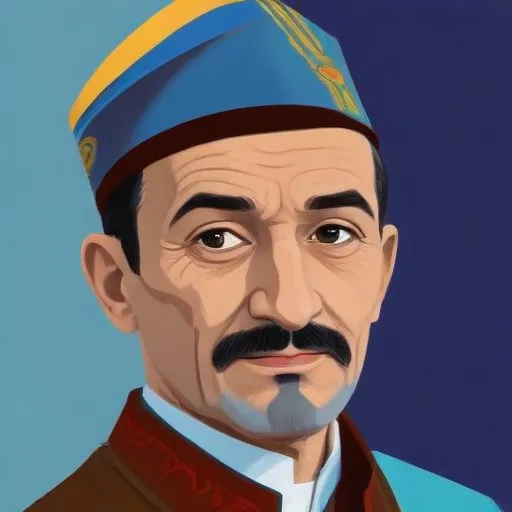
A Crimean Tatar visionary who championed education, publishing, and politics to empower his community, leaving a lasting legacy in the region.
Ismail Gasprinski, a renowned Tatar intellectual and writer, is widely regarded as the father of modern Tatar literature. His groundbreaking work in promoting education, community development, and cultural heritage has left an indelible mark on the Tatar people, earning him a revered place in the annals of history.
Born on March 8, 1851, in the village of Avci, Crimea, Gasprinski received his primary education at a local madrasa. He later pursued higher studies in Istanbul, where he became acquainted with the ideas of European modernism and nationalism. This exposure would shape his future endeavors and profoundly impact the Tatar community.
Gasprinski's literary prowess is evident in his pioneering work, Terjuman, a Tatar-language newspaper he founded in 1883. This publication became a beacon of intellectual and cultural enlightenment, showcasing Gasprinski's passion for promoting education, social reform, and literary excellence. Terjuman played a pivotal role in standardizing the Tatar language, fostering a sense of national identity, and bridging the divide between traditional Islamic values and modern European ideas.
As a visionary, Gasprinski advocated for far-reaching reforms in education, religion, and society. He emphasized the need for secular education, arguing that it would empower the Tatar people and equip them to thrive in a rapidly changing world. His philosophy centered on the importance of individual freedom, social justice, and cultural preservation.
Gasprinski's philanthropic efforts were multifaceted. He founded several schools, libraries, and cultural institutions, which provided a platform for the Tatar community to engage with their heritage and develop a sense of unity. His initiatives in education, healthcare, and social welfare improved the lives of countless individuals, earning him the respect and admiration of his people.
Ismail Gasprinski's legacy extends far beyond his literary and journalistic achievements. He inspired a generation of Tatar intellectuals, writers, and reformers, shaping the course of modern Tatar history. His tireless efforts to promote education, social justice, and cultural preservation have made him a symbol of national pride and an enduring icon in the Tatar community.
Gasprinski married Zöhre Akçurin, a prominent Tatar educator, in 1884. Together, they had four children, and their partnership was marked by a shared commitment to education and social reform. Throughout his life, Gasprinski received numerous accolades for his contributions, including the prestigious Order of Saint Vladimir from the Russian Empire.
Gasprinski's far-reaching influence can be seen in the many Tatar cultural and educational institutions that continue to thrive today. His emphasis on individual freedom, social justice, and cultural preservation has inspired generations of Tatar people to strive for a better life. As a testament to his legacy, the Republic of Tatarstan has named numerous schools, libraries, and cultural centers in his honor.
Gasprinski's life and work can be contextualized within the broader framework of late 19th- and early 20th-century European modernism and nationalism. His efforts to promote education, social reform, and cultural preservation share parallels with the work of contemporaries such as Ismail Kemal Bey and Ahmed Midhat Efendi, who were also championing similar causes in the Ottoman Empire.
Ismail Gasprinski's remarkable life and achievements serve as a testament to the power of education, cultural preservation, and community development. As a beacon of inspiration, his legacy continues to illuminate the path for future generations, solidifying his place as one of the most important figures in modern Tatar history.
Born in 1725
Reigned from 1774 to 1789, this Ottoman sultan implemented reforms, strengthened the military, and fought wars with Russia and Austria, leaving a lasting impact on the empire's politics and economy.
Born in 1881
Founder of modern Turkey, leading the country's transition from the Ottoman Empire to a secular, democratic nation, and implementing sweeping reforms in education, law, and women's rights.
Born in 1876
A pioneering figure in Turkish sociology, he's renowned for blending nationalism with Western modernity, shaping Turkey's cultural identity through his poetry and activism.
Born in 1876
A Tatar-Turkish activist and ideologue who promoted the idea of Turanism, a pan-Turkic movement that sought to unite Turkic peoples across the world. He's known for his influential writings on Turkish nationalism and identity.
