


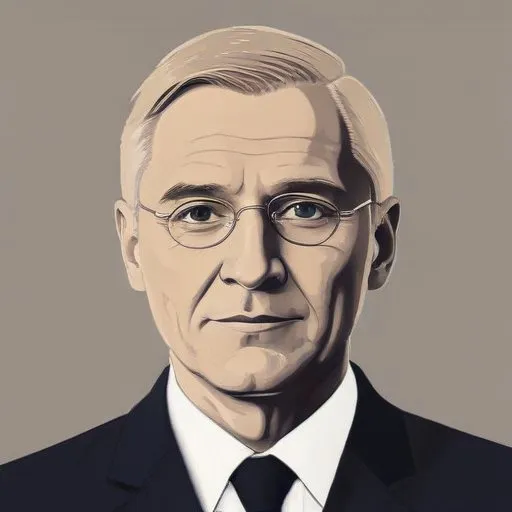
Estonia's first Minister of Foreign Affairs, a key figure in the country's struggle for independence and sovereignty, instrumental in shaping its international relations.
Jaan Poska, a renowned Estonian barrister and politician, is best known for his instrumental role in Estonia's fight for independence in the early 20th century. As a key figure in the country's struggle for self-governance, Poska played a pivotal role in shaping the young nation's destiny.
Born on January 24, 1866, in Laiusevlja, Estonia, Poska was the fifth of 12 children to a Russian Orthodox parish schoolmaster. He received his secondary education at the Orthodox church's school in Riga, before going on to study medicine at the University of Tartu. However, he soon transferred to law, graduating in 1890.
Poska became the first ethnic Estonian admitted to the bar in Tallinn, where he worked as a barrister. His dedication to public service led him to become the mayor of Tallinn from 1913 to 1917, during which he implemented several reforms, including the establishment of two schools and improvements to the city's healthcare system.
In April 1917, Poska became the governor of the Autonomous Governorate of Estonia, leading the Maapev to proclaim itself the supreme legal authority of Estonia. Following Estonia's declaration of independence on February 24, 1918, Poska played a crucial role in securing diplomatic recognition for the young nation.
As the Minister of Foreign Affairs of Estonia, Poska worked tirelessly to gain international recognition for his country. He participated in the Paris Peace Conference and led the peace talks with Soviet Russia, resulting in the Treaty of Tartu in 1920. This landmark treaty helped establish Estonia's sovereignty and paved the way for its future development.
Jaan Poska's personal life was marked by a strong sense of family and dedication to public service. His daughter, Vera Poska-Grünthal, went on to become a leading Estonian feminist and lawyer. American lawyer Sharon L. Gleason is Poska's great-granddaughter.
Poska's untimely death on March 7, 1920, at the age of 54, sent shockwaves throughout Estonia. His funeral was attended by 20,000 mourners, a testament to the profound impact he had on his country.
Jaan Poska's legacy extends far beyond his remarkable life. He played a crucial role in shaping Estonia's future, paving the way for its development as an independent nation. Today, he is remembered as a champion of Estonian independence and a true statesman.
In conclusion, Jaan Poska's life was a testament to his unwavering dedication to his country and its people. His remarkable achievements have left an indelible mark on Estonian history, cementing his place as one of the nation's most revered statesmen.
Born in 1874
Estonia's first president, a key figure in the country's struggle for independence from Russia, served as a unifying force during tumultuous times. He's remembered for his role in shaping Estonia's early years and its path to sovereignty.
Born in 1870
State Elder of Estonia, serving as the head of government from 1924 to 1925, known for his contributions to Estonia's early independence and development.
Born in 1884
Estonia's 7th Prime Minister, a lawyer and politician who played a crucial role in shaping the country's early years of independence, known for his diplomatic efforts and national unification.
89 Years Old
A Finnish statesman and Nobel laureate who served as President of Finland and mediated several international conflicts, earning him the Nobel Peace Prize in 2008.
97 Years Old
Estonian filmmaker and statesman who served as the country's president from 1992 to 2001, known for his efforts to integrate Estonia into the European Union and NATO. He was also a prolific writer and director, producing several documentaries and feature films.
72 Years Old
A Swedish-Estonian journalist and politician who served as the 4th President of Estonia, known for his efforts to promote e-government and digitalization in the country. He's a strong advocate for a free and open internet.
56 Years Old
The first female President of Estonia, serving from 2016 to 2021, known for her strong advocacy for climate action, digitalization, and e-government. She has been a vocal critic of authoritarianism and a champion of liberal democracy.
