


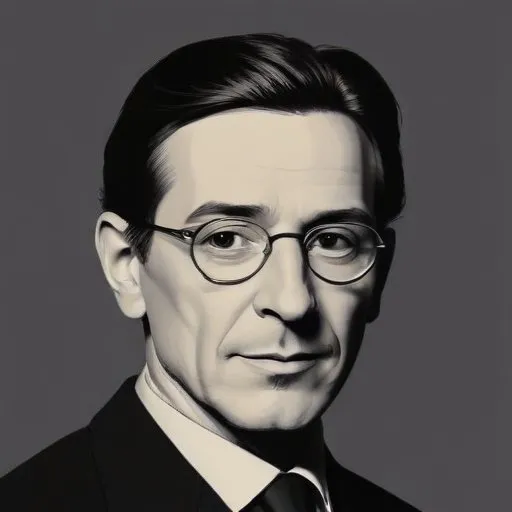
A Pulitzer Prize-winning composer and educator, known for his innovative and eclectic style, blending modernist and avant-garde techniques with traditional forms.
Jacob Druckman, a renowned American composer, left an indelible mark on the music world with his innovative and eclectic style, which seamlessly blended traditional and electronic elements. Born on June 26, 1928, in Philadelphia, Druckman was recognized for his groundbreaking contributions to the world of classical music, earning him the prestigious Pulitzer Prize in 1972.
Druckman's passion for music began at a young age, and he went on to study at the Juilliard School, where he graduated in 1956. His educational journey continued with esteemed mentors such as Vincent Persichetti, Peter Mennin, and Bernard Wagenaar. Additionally, he had the privilege of studying with Aaron Copland at Tanglewood in 1949 and 1950, and later at the École Normale de Musique in Paris from 1954 to 1955.
Druckman's body of work is characterized by its remarkable diversity, ranging from electronic music to orchestral pieces and chamber music. His breakthrough work, Windows, earned him the Pulitzer Prize in 1972, solidifying his position as a leading composer of his time. Other notable compositions include Astral, Prism, and Lamia, which showcased his mastery of symphonic and chamber music.
Druckman's impact on the music world extended beyond his compositions, as he shared his knowledge and expertise with future generations of musicians. He taught at renowned institutions such as Juilliard, The Aspen Music Festival, Tanglewood, Brooklyn College, Bard College, and Yale University. His influence can be seen in the many talented composers who studied under his guidance.
Druckman's contributions to music were recognized with numerous awards and honors, including the Pulitzer Prize, Guggenheim Fellowships, and the Connecticut State Composer Laureate. His legacy continues to inspire new talent, with the Aspen Music Festival awarding the Jacob Druckman Prize to emerging composers each year.
Druckman's personal life was marked by significant milestones, including his marriage to whom he had a son, Daniel Druckman, a percussionist. He passed away on May 24, 1996, at the age of 67, leaving behind a rich legacy that continues to shape the music world. His music is published by Boosey & Hawkes, ensuring that his compositions remain accessible to audiences and musicians alike.
Druckman's works have been performed and recorded by many esteemed musicians, including David Zinman, Wolfgang Sawallisch, Zubin Mehta, Leonard Slatkin, Dawn Upshaw, Jan DeGaetani, Dorian Wind Quintet, the Orpheus Chamber Orchestra, and the American Brass Quintet. These performances have helped to cement his reputation as a visionary composer of the 20th century.
Druckman's innovative approach to composition has had a profound impact on modern music, pushing the boundaries of traditional forms and exploring new sonic landscapes. His legacy serves as a testament to the power of creativity and innovation, inspiring future generations of composers to experiment and push the boundaries of what is possible.
Born in 1908
A pioneering composer of modern classical music, known for his complex and innovative works that pushed the boundaries of harmony and rhythm.
Born in 1910
A renowned pianist and composer who blended romanticism and modernism, creating iconic works like "Adagio for Strings" that evoke powerful emotions.
Born in 1910
A renowned composer and educator, he was the first president of the Juilliard School and won the Pulitzer Prize for Music in 1943. He's known for his contributions to American classical music.
Born in 1894
A renowned composer, theorist, and academic who made significant contributions to the development of American classical music, particularly in the realm of harmony and counterpoint.
Born in 1896
A renowned composer, conductor, and educator who made significant contributions to American classical music, particularly through his Romantic-style symphonies and leadership of the Eastman School of Music.
Born in 1918
A renowned musician who blended jazz, classical, and Broadway styles, creating iconic works like West Side Story, and inspiring generations with his charismatic performances and innovative compositions.
Born in 1900
A renowned composer, conductor, and educator who blended folk and modernist elements to create iconic American classical music, including "Appalachian Spring" and "Fanfare for the Common Man".
