


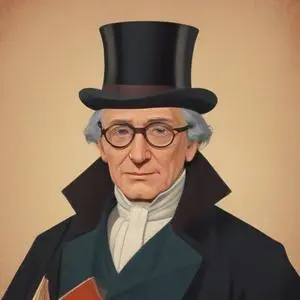
A renowned scholar who collected and published folktales, such as Cinderella and Snow White, and studied the origins of the German language. His work has had a lasting impact on literature and popular culture.
Jacob Grimm, a renowned German author, linguist, philologist, jurist, and folklorist, is best known for formulating Grimm's Law of linguistics and co-authoring the Deutsches Wörterbuch, a comprehensive German dictionary. Alongside his brother Wilhelm, he edited the iconic Grimm's Fairy Tales, a collection of Germanic folktales that has captivated readers for centuries.
Born on January 4, 1785, in Hanau, Hesse-Kassel, Jacob's early life was marked by hardship when his father, Philipp Grimm, a lawyer, passed away, leaving his mother, Dorothea, to raise him and his younger brother Wilhelm with limited financial resources. Despite these challenges, Jacob's aunt, who was lady-in-waiting to the Landgravine of Hesse, helped support and educate the family.
Jacob attended the public school in Kassel in 1798, followed by the University of Marburg in 1802, where he studied law, as intended by his father. His brother Wilhelm joined him a year later, and they both became enamored with the lectures of Friedrich Carl von Savigny, a prominent expert on Roman law.
Savigny's lectures had a profound impact on Jacob, inspiring him to delve into historical and antiquarian research, which became a hallmark of his work. During his time in Marburg, Jacob also discovered Bodmer's edition of Middle High German minnesingers and other early texts, sparking his interest in the language and literature of the Middle Ages.
In 1805, Savigny invited Jacob to Paris to assist him in his literary work, where he further developed his taste for medieval literature. Upon his return to Kassel, Jacob began to focus on Germanic linguistics, folklore, and mythology, laying the foundation for his groundbreaking work.
Jacob's contributions to Germanic linguistics and folklore are immeasurable. His formulation of Grimm's Law, which describes the patterns of sound change in Germanic languages, revolutionized the field of linguistics. The Deutsches Wörterbuch, which he co-authored with his brother Wilhelm, remains an indispensable reference for German language scholars to this day.
Their collection of folktales, Grimm's Fairy Tales, has become a cultural phenomenon, captivating readers of all ages with stories like Cinderella, Snow White, and Hansel and Gretel. These tales have not only entertained but also preserved the cultural heritage of the German people.
Jacob remained close to his brother Wilhelm throughout his life, and their collaborative efforts have left an indelible mark on the world of linguistics and folklore. Their partnership was built on a foundation of mutual respect, trust, and a shared passion for learning.
Jacob Grimm was elected a member of the Royal Swedish Academy of Sciences in 1845 and received honorary doctorates from the University of Marburg and the University of Berlin. His contributions to linguistics, folklore, and literature have earned him a lasting legacy, and his work continues to inspire scholars and readers alike.
By delving into the life and work of Jacob Grimm, we can gain a deeper appreciation for the rich cultural heritage of Germany and the importance of preserving our linguistic and folkloric traditions.
"Language is the road map of a culture. It tells you where its people come from and where they are going."
"The folk tale is the shortest distance between the past and the present."
These quotes, attributed to Jacob Grimm, reflect his deep understanding of the power of language and folklore to shape our understanding of ourselves and our place in the world.
Born in 1786
Collector of Germanic folk tales and fairy stories, including Cinderella and Hansel and Gretel, which remain beloved around the world today.
Born in 1805
A Danish master of fairy tales, crafting whimsical stories like "The Little Mermaid" and "The Ugly Duckling" that have captivated readers for generations. His works have become an integral part of Western cultural heritage.
Born in 1628
A 17th-century French author and academic who wrote beloved fairy tales, including "Cinderella" and "Sleeping Beauty", that have become timeless classics.
Born in 1773
A German Romantic poet, author, and critic who wrote influential works of fantasy and horror, shaping the genre and inspiring later writers like Edgar Allan Poe.
Born in 1776
A German Romantic-era mastermind who crafted dark, fantastical tales and composed mesmerizing music, leaving an indelible mark on literature and classical music.
Born in 1797
A 19th-century literary mastermind who penned poignant poetry and biting social commentary, known for his witty satire and romantic verses that still resonate today.
Born in 1813
A revolutionary composer who transformed opera with his epic, mythological works, creating a new era of musical storytelling. His iconic operas, such as "Der Ring des Nibelungen," continue to captivate audiences worldwide.
