


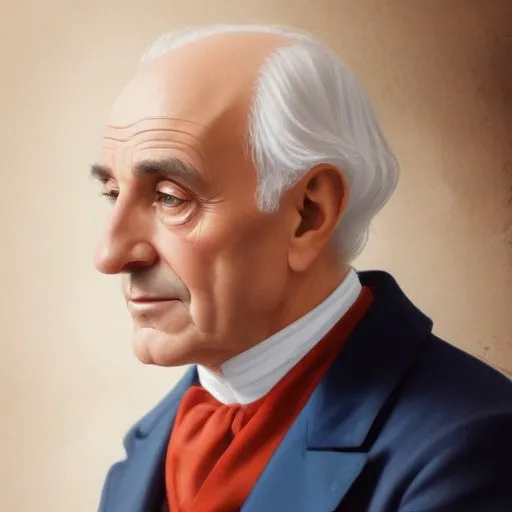
A Renaissance poet and scholar who crafted elegant Latin verse and witty epigrams, influencing the development of Italian literature and the Renaissance humanist movement.
Jacopo Sannazaro is renowned for his masterpiece, Arcadia, a humanist classic that exemplified the possibilities of poetical prose in Italian and introduced the theme of Arcadia, an idyllic land, to European literature. This 15th-century poet, humanist, and member of the Accademia Pontaniana from Naples is celebrated for his elegant style, which inspired numerous courtly literature of the 16th century.
Born on July 28, 1458, in Naples, Sannazaro came from a noble family of the Lomellina, claiming descent from Lombard territory. After his father's death around 1462, he was brought up in Nocera Inferiore and San Cipriano Piacentino, where the rural atmosphere greatly influenced his poetry.
Sannazaro's writing prowess earned him fame as a poet and a place as a courtier. He wrote with ease in Latin, Italian, and Neapolitan, but Arcadia, completed around 1489, remains his magnum opus. This work not only showcased his mastery of poetical prose but also introduced the concept of Arcadia, an idyllic land, to European literature.
Sannazaro's patron, Alfonso, played a significant role in his early career. He campaigned with Alfonso against papal forces near Rome in 1483-1485. After Alfonso's death in 1495, Sannazaro received a villa in Mergellina near Naples from Frederick IV.
However, when Frederick IV capitulated to France and Aragon, Sannazaro followed him into exile in France in 1501. He returned to Mergellina after Frederick's death at Tours in 1504.
In 1525, Sannazaro succeeded the humanist Pietro Summonte as head of the Pontanian academy. He spent his later years in Naples, continuing to write and inspire generations of writers.
Today, Jacopo Sannazaro is remembered as a pioneer of humanist literature, whose work continues to influence writers and poets across Europe.
Though Sannazaro's quotes are scarce, his works speak volumes about his poetic vision and humanist ideals:
"In Arcadia, all is peaceful, tranquil, and serene; the very air is filled with the sweet scent of flowers, and the gentle songs of birds."
Sannazaro's life and work spanned a tumultuous period in European history, marked by wars, royal patronage, and the emergence of humanist ideals. His contributions to Italian literature and the Arcadia theme have left an indelible mark on European literary heritage.
As a testament to his legacy, Sannazaro's Arcadia remains a cornerstone of humanist literature, continuing to inspire writers, poets, and scholars alike.
Born in 1470
A 16th-century Renaissance humanist who wrote influential poetry and treatises on literature, and was a key figure in developing the modern Italian language.
Born in 1466
A 16th-century Renaissance humanist who advocated for education, tolerance, and critical thinking, and is famous for his witty and insightful writings, particularly "In Praise of Folly".
Born in 1474
Renowned for epic poems, particularly "Orlando Furioso", which masterfully blended chivalric romance and Renaissance humanism, influencing literature for centuries.
Born in 1469
Italian historian and philosopher who wrote "The Prince", a seminal work on politics and power that still influences modern leadership and governance today.
Born in 1478
A Renaissance man who wrote "The Courtier," a influential book on etiquette and courtly behavior, shaping the ideal of the perfect gentleman. His work remains a cornerstone of Western cultural heritage.
Born in 1463
Renaissance humanist and philosopher who wrote the famous "Oration on the Dignity of Man," a treatise that declared human beings' potential for greatness and their capacity for self-improvement. He's known for his emphasis on humanism and individualism.
