


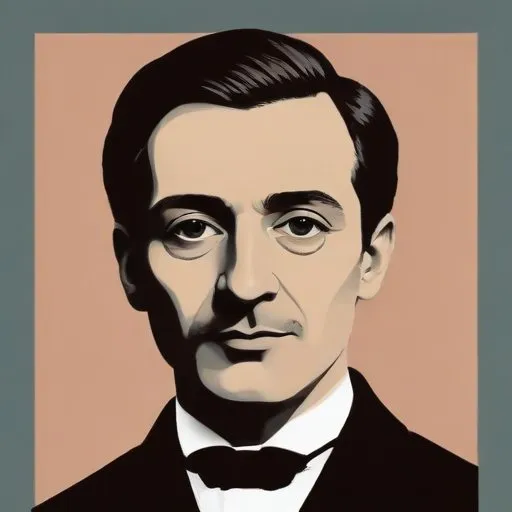
Developed influential mathematical theories, particularly in the field of differential equations, and made significant contributions to the study of algebraic equations.
French mathematician Jacques Charles Franois Sturm is renowned for his groundbreaking contribution to equation theory, specifically his work on Sturm's theorem, which has become a cornerstone in the field of mathematics. This theorem, discovered in 1829, concerns real-root isolation, enabling the determination of the number and localization of real roots of a polynomial.
Sturm was born in Geneva, France on September 29, 1803, to Jean-Henri Sturm and Jeanne-Louise-Henriette Gremay. His family had emigrated from Strasbourg around 1760, nearly 50 years before his birth. Sturm's fascination with mathematics began early, and he started attending lectures at the Academy of Geneva in 1818. After his father's untimely death, he took on tutoring roles to support his family, eventually becoming a tutor to the son of Madame de Staël in 1823.
The 1830 revolution brought about a significant turning point in Sturm's life. As a Protestant, he was no longer barred from employment in public high schools, and he was appointed professor of Mathématiques Spéciales at the Collège Rollin. This marked the beginning of his illustrious career, which would see him become a member of the Académie des Sciences in 1836, replacing André-Marie Ampère.
Sturm's work had a profound impact on various fields, including mathematics, physics, and engineering. His theorem, which bears his name, has been instrumental in solving equations and determines the number of real roots of a polynomial. He also made significant contributions to the development of the Sturm-Liouville theory, alongside Joseph Liouville.
Jacques Charles Franois Sturm's contributions to mathematics have had a lasting impact on the field. His work on Sturm's theorem and the Sturm-Liouville theory has paved the way for numerous breakthroughs in various disciplines. His legacy continues to inspire mathematicians and scientists, ensuring his place as one of the most influential mathematicians of the 19th century.
Sturm's life serves as a testament to the power of perseverance and determination. Despite facing numerous challenges, he remained committed to his passion for mathematics, ultimately leaving an indelible mark on the field. His story continues to inspire generations of mathematicians, scientists, and thinkers, ensuring his legacy endures.
Born in 1749
Developed nebular hypothesis of the origin of the solar system and formulated Laplace's equation, a fundamental concept in mathematics and physics. He's considered the founder of celestial mechanics.
Born in 1736
Developed calculus, number theory, and celestial mechanics, making significant contributions to the fields of mathematics and astronomy.
Born in 1752
Developed the theory of elliptic integrals, and his work on number theory laid the foundation for modern cryptography.
Born in 1777
A pioneer in mathematics and physics, he made major contributions to number theory, algebra, and electromagnetism, shaping our understanding of the natural world.
Born in 1789
Developed rigorous mathematical theories and introduced concepts like convergence and continuity, revolutionizing calculus and paving the way for modern mathematics.
Born in 1802
A pioneer in mathematics, he made groundbreaking contributions to the field of algebra, particularly in the development of group theory and the proof of the impossibility of solving quintic equations using radicals.
Born in 1811
Developed the theory of groups, which revolutionized algebra and paved the way for modern number theory, and his work laid the foundation for many mathematical and scientific advancements.
Born in 1826
A pioneering mathematician who developed the theory of higher dimensions and laid the foundations for modern physics, particularly in the understanding of space and time.
