


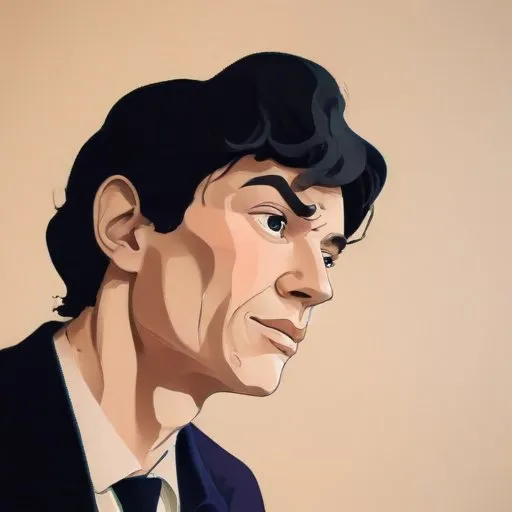
A French artist who created exquisite sculptures and paintings, particularly notable for his work on the equestrian statue of Frederick V of Denmark.
Jacques Saly, a French-born sculptor, is widely renowned for his breathtaking equestrian statue of Frederik V on Horseback, a masterpiece that adorns the Amalienborg Palace in Denmark. This iconic work not only cemented Saly's reputation as a premier sculptor of his time but also symbolizes his profound impact on European art.
Born on June 20, 1717, in Valenciennes, France, Saly was the son of Franois Marie Saly and Marie-Michelle Jardez. His artistic journey began at the tender age of nine, when he started training under local master Antoine Gilles in Valenciennes. This early foundation laid the groundwork for his future success.
In 1732, Saly's talent earned him a spot in the studio of Guillaume Coustou, a leading sculptor in Paris. During this period, he also attended the school of the Académie royale de peinture et de sculpture, where he won medals in 1734, 1737, and 1738. His first-place win in the Prix de Rome competition in 1738 granted him the opportunity to study at the French Academy in Rome, a prestigious institution that fostered the development of artistic talent.
Saly's eight-year tenure in Rome (1740-1748) was a pivotal period in his career. He honed his skills by creating marble copies of Roman sculptures for the French king and perfected his artistic taste through the study of antiquities and the masters of the past. During this time, he also created a monumental portrait bust of Manuel Pinto de Fonseca, Grand Master of the Order of Malta (1742), and a bust of a little girl (1744), which has become one of the most reproduced sculptures from the 18th century.
Saly's accomplishments earned him membership in several prestigious art academies, including the Accademia degli Arcadi in Rome (1744), the Academy of Design at Florence (1748), and the Accademia di Belli Arti in Bologna (1748).
In 1754, Saly was appointed Director of the Royal Danish Academy of Art, a position he held until 1771. During his tenure, he played a crucial role in shaping the artistic landscape of Denmark, inspiring a new generation of artists and leaving an indelible mark on the country's cultural heritage.
Saly's body of work embodies the neoclassical spirit of his era, characterized by a deep reverence for classical antiquity and a commitment to artistic excellence. His contributions to the world of sculpture have had a lasting impact, influencing artists and art movements for centuries to come.
Through his remarkable talent, dedication, and perseverance, Jacques Saly has left an enduring legacy in the world of art, inspiring generations of artists and art lovers alike.
As we reflect on Saly's remarkable career, we are reminded of the power of art to transcend time and touch the human spirit. His extraordinary contributions continue to enrich our cultural heritage, ensuring that his name will forever be etched in the annals of art history.
Born in 1732
A prolific Rococo painter and etcher, renowned for his delicate, whimsical, and often erotic works that capture the carefree spirit of 18th-century French aristocracy. His art often featured lush landscapes, gentle colors, and playful scenes of love and leisure.
Born in 1703
A prominent artist of the Rococo style, known for his delicate and ornate paintings, often depicting mythological and pastoral scenes, as well as designing sets for the Paris Opera.
Born in 1741
A renowned French sculptor and educator, famous for his incredibly lifelike and expressive portraits of prominent figures, including Voltaire, Rousseau, and Napoleon.
Born in 1714
A renowned French sculptor and educator, he revolutionized 18th-century art with his neoclassical masterpieces, including iconic works like "Voltaire Nude" and "Mercury Attaching His Wings".
Born in 1725
A French painter and educator renowned for his sentimental and moralizing genre scenes, often depicting young women in domestic settings, which captivated 18th-century audiences.
Born in 1770
A prominent Neoclassicist painter, renowned for his elegant and refined portraits of European aristocracy, capturing the essence of his subjects with precision and subtlety.
