Unveiling the Artistic Mastery of Jean-Antoine Houdon

The Neoclassical Sculptor Who Immortalized the Enlightenment
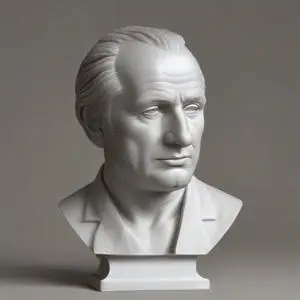
Jean-Antoine Houdon, the French neoclassical sculptor, is renowned for his captivating portrait busts and statues of prominent figures from the Enlightenment era. His impressive repertoire includes masterpieces of philosophers, inventors, and political leaders, cementing his reputation as one of the most celebrated sculptors of his time.
A Life Devoted to Artistic Excellence
Born on March 20, 1741, in Versailles, Houdon's artistic journey began at the tender age of 11, when he entered the Académie royale de peinture et de sculpture. Under the guidance of esteemed masters like Ren-Michel Slodtz, Jean-Baptiste Lemoyne, and
Jean-Baptiste Pigalle, Houdon honed his skills, eventually winning the prestigious Prix de Rome in 1761.
A Roman Sojourn and the Emergence of a Master
Houdon's four-year stay in Rome (1761-1764) was a pivotal period in his artistic development. During this time, he created the iconic anatomical model, "Écorché," which would become a guiding reference for artists for centuries to come. His Rome sojourn also saw the birth of the magnificent statue of Saint Bruno, now residing in the church of Santa Maria degli Angeli e dei Martiri.
Portrait Busts and a Who's Who of the Enlightenment
Upon his return to Paris, Houdon's focus shifted to portrait busts, which would become his hallmark. His impressive list of subjects includes luminaries like
Denis Diderot,
Benjamin Franklin,
Jean-Jacques Rousseau, Voltaire, Molière,
George Washington,
Thomas Jefferson, Louis XVI,
Robert Fulton, and
Napoleon Bonaparte, among others. These masterpieces not only showcased his technical brilliance but also captured the essence and character of his subjects.
Masonic Connections and Transatlantic Encounters
Houdon's membership in the masonic lodge Les Neuf Sœurs brought him into contact with influential figures like Benjamin Franklin and
John Paul Jones. This connection led to a significant invitation from Franklin to visit Mount Vernon, where Houdon modeled a portrait bust of George Washington in 1785.
Awards, Honors, and a Lasting Legacy
Throughout his illustrious career, Houdon received numerous accolades, including membership in the Académie de peinture et de sculpture (1771) and professorship in 1778. His contributions to the world of art and sculpture have endured, inspiring generations of artists and art lovers alike.
Trivia and Fun Facts
- Houdon's Écorché, created in 1767, is considered one of the most important anatomical models in the history of art.
- He submitted two busts of Voltaire to the Salon of 1778, one for the Comédie-Française and another for the Palace of Versailles.
- Houdon's portrait bust of Washington was the first to be created from life, making it an invaluable artistic and historical treasure.
As we delve into the life and works of Jean-Antoine Houdon, we are reminded of the power of art to immortalize the human spirit. His exquisite creations continue to inspire and educate, serving as a testament to his mastery and the enduring legacy of neoclassical sculpture.
FAQ
What was Jean-Antoine Houdons role in the development of neoclassicism?
Jean-Antoine Houdon was a French sculptor and educator who played a significant role in the development of neoclassicism. His sculptures, which often depicted mythological and historical figures, helped to popularize the neoclassical style during the 18th century.
What was Jean-Antoine Houdons most notable sculpture?
Jean-Antoine Houdons most notable sculpture was his bust of Voltaire, which is widely regarded as one of the greatest portraits of the 18th century. The bust captured the essence of Voltaires personality and intellect, and it remains one of Houdons most celebrated works.
How did Jean-Antoine Houdons teaching influence the development of French sculpture?
Jean-Antoine Houdons teaching had a profound influence on the development of French sculpture. He was a respected educator who taught at the École des Beaux-Arts in Paris, and his students went on to become prominent sculptors in their own right.
What was Jean-Antoine Houdons relationship with the French Enlightenment?
Jean-Antoine Houdon had a close relationship with the French Enlightenment, which was a cultural and intellectual movement that emphasized reason, individualism, and progress. Many of his sculptures depicted Enlightenment figures and ideals, and his work helped to popularize the movements values.
Is Jean-Antoine Houdons work still studied today?
Yes, Jean-Antoine Houdons work is still studied today by art historians and scholars. His sculptures are highly regarded for their beauty, expressiveness, and historical significance, and they continue to inspire artists and art lovers around the world.