


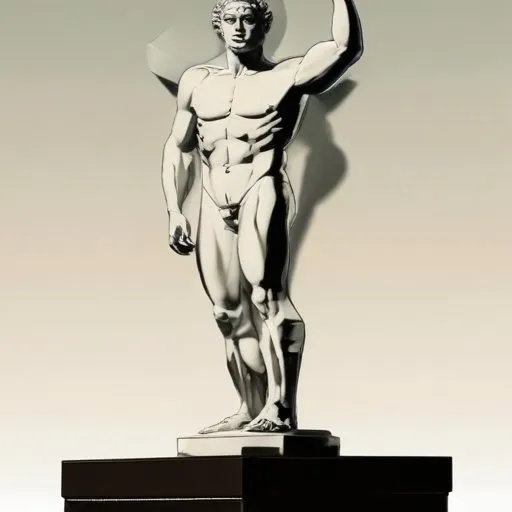
Étienne Maurice Falconet, a French sculptor of remarkable talent, is best known for his iconic equestrian statue of Peter the Great, the Bronze Horseman (1782), which stands majestically in St. Petersburg, Russia. This monumental masterpiece not only cemented Falconet's reputation as a master of his craft but also earned him international acclaim.
Born on December 1, 1716, in Paris, Falconet came from a poor family and was initially apprenticed to a marble-cutter. However, his innate talent and dedication led him to create clay and wood figures in his spare time, which eventually caught the attention of the renowned sculptor Jean-Baptiste Lemoyne. Under Lemoyne's guidance, Falconet refined his skills and laid the foundation for a lifetime of artistic excellence.
Falconet's early success was marked by his admission to the prestigious Académie royale de peinture et de sculpture in 1754, following the exhibition of his remarkable sculpture, Milo of Croton. This achievement was followed by his participation in the Salons of 1755 and 1757, where he showcased his marbles L'Amour (Cupid) and Nymphe descendant au bain (The Bather), now housed at the Louvre.
In 1757, Falconet was appointed director of the sculpture atelier at the Manufacture royale de porcelaine at Sèvres by the influential Marquise de Pompadour. During his tenure, he revolutionized the production of unglazed soft-paste porcelain figurines, creating exquisite small-scale sculptures that captivated European aristocracy. His collaborations with the painter François Boucher and the world of theater and ballet are evident in his works, characterized by elegance, refinement, and a subtle eroticism.
In 1766, Falconet was invited by Catherine the Great to Russia, where he created some of his most celebrated works, including the Bronze Horseman. This monumental equestrian statue not only showcased Falconet's mastery of technique but also solidified his reputation as a virtuoso of sculpture.
Falconet's contributions to the world of art and sculpture are immeasurable. His innovative approaches to porcelain production and his mastery of equestrian sculpture continue to inspire artists to this day. As a testament to his enduring influence, Falconet's works remain an integral part of cultural heritage, educating and delighting audiences across the globe.
Born in 1741
A renowned French sculptor and educator, famous for his incredibly lifelike and expressive portraits of prominent figures, including Voltaire, Rousseau, and Napoleon.
Born in 1732
A prolific Rococo painter and etcher, renowned for his delicate, whimsical, and often erotic works that capture the carefree spirit of 18th-century French aristocracy. His art often featured lush landscapes, gentle colors, and playful scenes of love and leisure.
Born in 1703
A prominent artist of the Rococo style, known for his delicate and ornate paintings, often depicting mythological and pastoral scenes, as well as designing sets for the Paris Opera.
Born in 1748
A French painter and illustrator who revolutionized Neoclassicism with his realistic and emotive works, creating iconic pieces like "Oath of the Horatii" and "Napoleon Crossing the Alps".
Born in 1861
A pioneering artist who blended classical and modern styles, creating iconic sculptures and paintings that explored the human form and emotions.
Born in 1840
A French sculptor and illustrator famous for creating iconic, emotionally charged figures that capture the human experience, including the iconic symbol of intellectualism, The Thinker.
