


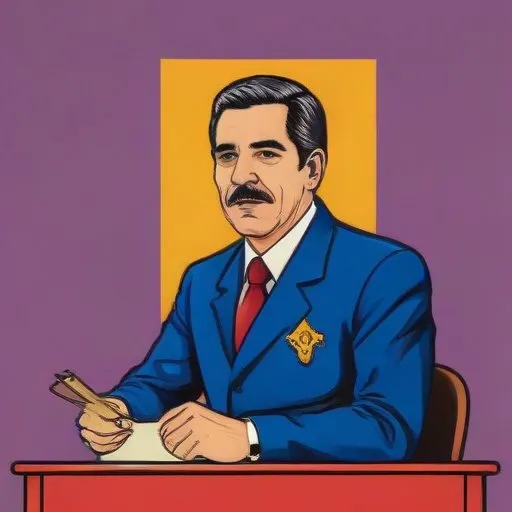
A Venezuelan physician-turned-politician who served as President of Venezuela from 1984 to 1989, known for his efforts to stabilize the country's economy and implement social reforms.
Jaime Lusinchi, a figure shrouded in controversy, is known for his tumultuous presidency of Venezuela from 1984 to 1989. During his term, Lusinchi's populist policies and alleged corruption exacerbated the country's economic crisis, leading to currency depreciation, inflation, and widespread discontent.
Jaime Lusinchi was born on May 27, 1924, in Clarines, Anzoátegui, to María Angelica Lusinchi, a woman of Italian-Corsican descent. Growing up without a father, Lusinchi attended elementary school in his native Clarines and Puerto Píritu, before pursuing high school education at the Federal School of Barcelona, Anzoátegui. He began studying medicine at the University of the Andes in Mérida in 1941, eventually transferring to the Central University of Venezuela, where he graduated in 1947.
In 1937, at the tender age of 13, Lusinchi joined the National Democratic Party, an organization founded by Rómulo Betancourt against the government of Eleazar López Contreras. In 1941, he was present at the foundation of the social democratic party Acción Democrática. During his college years, Lusinchi emerged as a political activist, serving as secretary of the School Medicine Council, vice president of the Venezuelan Association of Youth, and vice president of the Student Federation of Venezuela.
In 1948, Lusinchi was elected president of the Municipal Council of Freites District and president of the Legislative Assembly of Anzoátegui. His involvement in politics continued to grow, culminating in his presidency of Venezuela in 1984.
Lusinchi's presidency was marked by economic crisis, corruption, and populist policies. His administration's mismanagement of the economy led to currency depreciation, inflation, and a significant increase in Venezuela's external debt. Moreover, Lusinchi was accused of corruption, which further eroded the public's trust in the government.
Despite these controversies, Lusinchi remained popular during his presidency, and was succeeded by Carlos Andrés Pérez, a member of his Acción Democrática party.
Lusinchi's presidency had a lasting impact on Venezuela's political system, which was established in 1958. His legacy is marred by allegations of corruption and mismanagement, yet he remains a significant figure in Venezuelan politics.
In conclusion, Jaime Lusinchi's tumultuous presidency continues to be a topic of debate among historians and political analysts. While his populist policies and alleged corruption have been widely criticized, his significance in Venezuelan politics cannot be denied.
Born in 1916
A Venezuelan lawyer and politician who served as the 65th President of Venezuela, known for his efforts to reform the country's economy and politics, and for being a key figure in the country's transition to democracy.
Born in 1844
A self-taught artist who created vibrant, dreamlike jungle scenes and naive portraits, blending fantasy and realism with a unique, primitive style.
71 Years Old
The charismatic leader who transformed Venezuela through socialist reforms and anti-imperialist rhetoric, leaving a lasting impact on the country's politics and economy.
65 Years Old
A talented slugger who played 19 seasons in the MLB, earning five Gold Glove Awards and hitting 399 home runs, with a remarkable comeback from cancer.
